

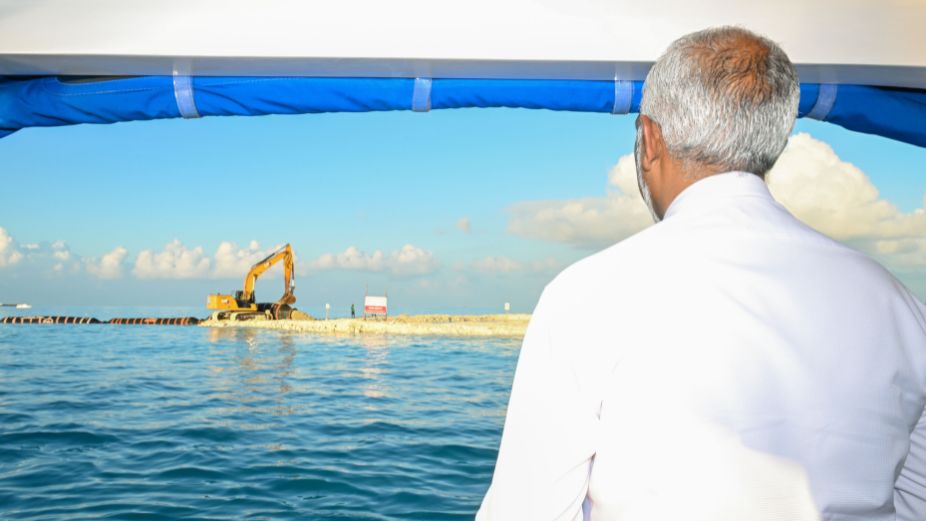






By any visual measure, the Maldives appears to be in the middle of a transformation. Dredgers churn in lagoons. Masterplans promise eco-cities rising from reclaimed sandbanks. Regional airports are mapped across atolls with mathematical neatness, each within thirty minutes of the next. Deep-water ports and bunkering hubs are sketched beside shipping lanes that carry the commerce of continents.
The ambition is undeniable. So is the mismatch. The Maldives today is not short of vision. It is short of absorptive capacity.
At the centre of the current development strategy lies Ras Malé, a 1,153-hectare land reclamation project in the Fushidhiggaru lagoon, envisioned as a zero-carbon urban extension to relieve pressure on Greater Malé. The plan is audacious: 65,000 housing units on land raised three metres above sea level, fortified against the ocean, integrated with modern infrastructure.
But the project’s execution history tells a different story. A contractor-financed model collapsed within months. The state paid USD 21 million in compensation after only 29 hectares were dredged. Financing arrangements shifted. External partners were sought. Budget allocations were revised. The dredgers returned, but so did the questions. Ras Malé is not an isolated case. It is a metaphor.
Across the archipelago, a decentralised aviation push aims to ensure that every inhabited island, resort and industrial zone sits within half an hour of a runway. Nine domestic airports were transferred to Maldives Airports Company Limited after the dissolution of the Regional Airports Company, reportedly in poor operational condition. Firefighting equipment failed. Maintenance lagged. Projects overlapped. One airport stalled while another began in the same atoll. The map of ambition expanded faster than the system that must sustain it.
Meanwhile, the Special Economic Zones framework has been revived with new minimum investment thresholds of USD 100 million for strategic investments and USD 500 million for “sustainable township” developments. These projects promise logistics hubs, ICT parks, renewable energy, tertiary hospitals, universities, and integrated townships powered largely by renewables. They also promise tax concessions and regulatory privileges designed to attract global capital.
The question is not whether such projects could be transformative. It is whether the state, as presently structured and financed, can absorb them. The numbers suggest strain.
In 2024, Public Sector Investment Programme expenditure reached MVR 11.9 billion, exceeding the approved budget by 34 per cent. Yet 1,311 budgeted projects recorded zero financial progress, tying up more than MVR 3.2 billion. At the same time, MVR 1.1 billion was spent on projects not included in the approved budget. Nearly 480 projects exceeded their allocations by more than 10 per cent, generating MVR 4.7 billion in overruns. The paradox is stark: overspending alongside stagnation.
By late 2025, the pendulum swung abruptly in the opposite direction. Capital expenditure contracted sharply year-on-year, by more than 50 per cent in some months, as financing constraints tightened. The boom had hit a fiscal ceiling.
The macroeconomic context is unforgiving. The 2026 budget projects total expenditure of MVR 64.2 billion against revenues of MVR 40.4 billion. Public and publicly guaranteed debt stands above 120 per cent of GDP, with external debt service peaking in 2026 at levels approaching USD 1.5 billion. A USD 500 million Sukuk matures this year. A USD 100 million bond falls due alongside it.
Infrastructure in the Maldives is import-heavy. Cement, steel, machinery, fuel, specialised labour, all are paid for in foreign currency. When reserves fall, projects slow. When the state delays payments, contractors stall.
Maldives Transport and Contracting Company, the country’s largest state-linked contractor, reported a 33 per cent revenue decline in 2024, citing delayed government payments and cash flow disruptions. Construction prices rose more than 13 per cent year-on-year. Access to credit tightened. The central bank’s surveys showed worsening financial conditions for construction firms even as contract awards continued.
It is possible to mistake activity for progress. A ground-breaking ceremony photographs well. A memorandum of understanding signals momentum. But absorptive capacity is less visible. It lies in procurement systems, in fiscal discipline, in digital governance, in the ability to cost projects accurately and sequence them rationally. It lies in whether the state can pay its bills on time.
Multilateral institutions have issued consistent warnings. The International Monetary Fund describes a high risk of debt distress. The World Bank urges urgent fiscal consolidation and sustainable infrastructure planning. The Maldives Monetary Authority notes that fiscal rationalisation will weigh on short-term growth, even as it becomes unavoidable.
None of this implies that infrastructure investment is misguided. For a geographically dispersed Small Island Developing State, connectivity is not a luxury. It is a precondition for economic survival. Housing shortages in Greater Malé are real. Diversification beyond tourism is necessary. Renewable energy capacity must expand. Maritime potential exists. The issue is tempo.
The Maldives is attempting to build an infrastructure profile suited to a capital-rich, high-income economy while operating with the fiscal buffers and administrative depth of a small, import-dependent state. The resulting misalignment produces volatility: aggressive expansion followed by abrupt contraction; mega-project announcements followed by liquidity freezes; overlapping aviation projects while basic maintenance falters. Infrastructure, when sequenced well, compounds national resilience. When sequenced poorly, it compounds debt.
The 2026 refinancing cliff is not merely a financial event. It is a test of credibility. If external markets perceive that the Maldives cannot align ambition with capacity, borrowing costs will rise, options will narrow, and adjustment will be forced rather than chosen.
The country’s development story need not become a cautionary tale. But it requires a recalibration. A moratorium on unbudgeted projects. A transparent audit of stalled investments. A prioritisation framework anchored in economic returns and foreign exchange generation. A plan to clear arrears to systemic contractors. A realistic sequencing of SEZ and township developments that protects sovereignty and avoids hidden liabilities.
There is a difference between thinking big and overreaching. The Maldives has demonstrated that it can think big. The next phase will determine whether it can build wisely.