



The police raid on Adhadhu’s newsroom has brought the Maldives’ press freedom debate into a more immediate and serious phase. For months, journalists and rights groups had warned that the country’s new media regulatory framework could be used to pressure independent reporting. The action against Adhadhu has now turned those concerns into a practical question: how much space remains for media scrutiny when reporting touches the highest levels of government?
The case centres on Adhadhu’s documentary Aisha, published on 28 March 2026, which carried allegations against President Dr Mohamed Muizzu. The President denied the claims, describing them as false, and warned that legal action would follow. Within hours of a press briefing in which an Adhadhu journalist questioned him on the matter, police entered the outlet’s office in Malé, seized electronic equipment and later imposed travel restrictions on senior figures at the organisation.
The government’s position is that the matter is not about suppressing journalism, but about responding to serious false allegations and protecting constitutional rights. Minister of Homeland Security, Labour and Technology Ali Ihusaan defended the police action by stating: “Spreading fabricated serious accusations is not journalism. Police are upholding the rule of law and the President’s constitutional rights. Responsible freedom comes with accountability. No one is above the law”.
That argument speaks to a real issue. Media freedom does not remove the responsibility to verify serious claims, especially when they involve private reputations and criminal or moral allegations. False reporting can cause lasting harm. A democratic society is entitled to expect professional standards from journalists and media organisations. The state also has a role in ensuring that individuals, including public officials, have legal remedies when they believe they have been defamed or wrongfully accused.
The concern, however, lies in the scale, speed and legal framing of the response. Police seized laptops, hard drives and other storage devices from the newsroom. Travel bans were imposed on Adhadhu CEO Hussain Fiyaz Moosa and Managing Editor Hassan Mohamed. The case was pursued not simply as a civil complaint or media ethics matter, but under Qazf provisions relating to false accusations of unlawful sexual intercourse. For many journalists, that distinction matters because it moves the issue from regulation or defamation into the realm of criminal law.
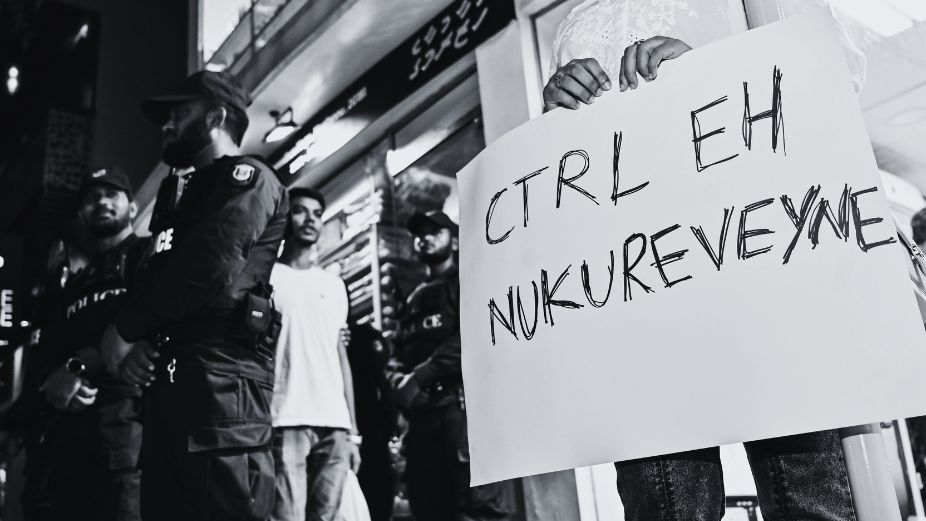
This is where the Adhadhu case has become larger than one outlet or one documentary. It has raised questions about whether legal tools in the Maldives are now being used in ways that could make investigative journalism riskier, especially when it involves powerful figures. The Committee to Protect Journalists warned that “The raid on Adhadhu and subsequent travel bans are an attempt to criminalize investigative journalism under the guise of religious and national interests. Using religious laws to bypass civil media regulations sets a chilling precedent. Authorities must allow the press to hold government offices accountable”.
The Maldives Journalists Association has also expressed alarm, arguing that the government has crossed a clear line in its treatment of the press. Its concern is not only about Adhadhu, but about the wider signal being sent to newsrooms. If a media organisation can face a raid, equipment seizures and travel restrictions after publishing politically sensitive allegations, other outlets may become more cautious even when they possess documents, whistleblower material or public interest information.
The new media law forms part of this context, though the Adhadhu case is not limited to that law alone. The Maldives Media and Broadcasting Regulation Act, ratified in September 2025, created a single regulator for print, broadcast and online media. The government has described it as a modern framework to deal with misinformation, professional standards and the responsibilities of the press. Its supporters argue that the previous system was outdated and that the rapid spread of online claims requires clearer regulation.
In practice, the law gives the new commission wide powers. It can investigate outlets, issue orders, impose fines, suspend registrations during investigations, block access to digital news websites and require live broadcasts to stop. Journalists can face fines of between MVR 5,000 and MVR 25,000, while outlets can be fined up to MVR 100,000. For independent media in the Maldives, where revenue is limited and the market is small, such penalties can carry serious consequences.
The law also places the new commission in a politically sensitive position. Three of its seven members are appointed by the President, who also selects the chairperson. Four members are elected by the media sector, but they can be removed by Parliament through a no-confidence vote. With the ruling People’s National Congress holding a strong parliamentary majority, critics argue that the commission may not be sufficiently insulated from political pressure.
Government officials and aligned MPs have argued that safeguards remain in place. They have said personal social media accounts are not the target of the law, that permanent closure of media outlets would require a court order, and that regulation is aimed at preventing harmful falsehoods rather than silencing criticism. Those assurances are important because misinformation is a legitimate public concern. The difficulty is that enforcement actions are now being measured against those assurances.
The Adhadhu raid followed an earlier dispute involving the same outlet. In January 2026, the media regulator ordered Adhadhu to remove a political cartoon that it said violated the basic tenets of Islam. Adhadhu challenged the reasoning and asked for clarification, but the episode led to the suspension of its satire segment. Seen together with the April raid, the incident has raised concern that regulatory and legal pressure may be used against forms of political expression that are uncomfortable for those in power.
The Maldives has experienced pressure on the press under previous governments as well. During former President Abdulla Yameen’s administration, media outlets faced heavy fines and other forms of official pressure. Under former President Ibrahim Mohamed Solih, amendments to the Evidence Act drew criticism because they allowed courts to compel journalists to reveal confidential sources in certain circumstances. The current moment therefore reflects a longer pattern in which governments of different political backgrounds have struggled with independent media scrutiny.
What makes the present moment distinct is the combination of a powerful new regulator, broad language around harmful content, and the use of criminal legal provisions in a high-profile case involving a sitting president. Each element may be defended separately by the state. Together, they create a press environment in which journalists may think twice before pursuing sensitive stories.
A fair assessment must acknowledge both sides of the issue. Media outlets should not be immune from scrutiny when they publish serious allegations. Journalism depends on credibility, verification and accountability. At the same time, the state’s response to disputed reporting must be proportionate, transparent and consistent with press freedom. A newsroom raid is not a routine response. Seizing journalistic material can affect source protection, editorial independence and the ability of an outlet to continue working.
The Adhadhu case has therefore become a defining test of how the Maldives balances reputation, regulation and the public’s right to know. The government says it is defending the rule of law and individual rights. Journalists and international organisations fear that the same tools may narrow the space for scrutiny. The outcome will matter beyond Adhadhu, because other newsrooms will read it as a signal of what happens when reporting reaches the centre of political power.
For a small democracy, press freedom is not an abstract principle. It is one of the few ways citizens can see how power is used between elections. If journalists are reckless, they should be answerable through fair and proportionate legal processes. If the state responds to critical reporting with raids, travel bans and broad criminal charges, the cost may be a quieter media environment where fewer questions are asked.
The central issue is no longer only whether the Maldives has a strict media law. It is whether the country’s legal and regulatory system can handle uncomfortable journalism without turning state power against the press. The Adhadhu case has made that question unavoidable.