

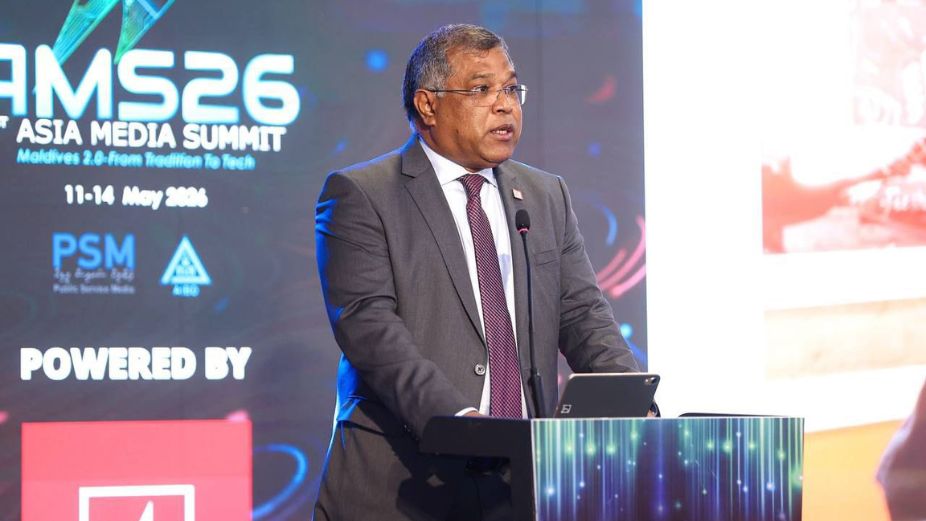




Bank of Maldives CEO Mohamed Shareef has said timely and accurate reporting plays an essential role in preserving public trust in the financial system, particularly as information now moves faster through digital platforms.
Speaking at the Asia Media Summit in the Maldives, Shareef said the financial sector and the media sector are closely connected, with responsible communication carrying particular importance when reporting on banks, financial institutions and the wider economy.
He said confidence in the financial system can be strengthened or weakened by the quality and accuracy of information shared with the public. This, he noted, affects not only customers and businesses, but also the international relationships that support the Maldivian economy, including correspondent banking partnerships, international investors, development institutions and global financial networks.
Shareef said media organisations have an important responsibility to ensure that public discourse on financial issues is accurate, verified and grounded in facts. He warned that misinformation and unverified narratives can create unnecessary uncertainty, with consequences that may extend beyond a single institution.
The remarks came as Shareef outlined the scale of digital change in the Maldivian banking sector. He said more than 99.7 percent of all transactions conducted through Bank of Maldives now take place outside a physical branch, reflecting a major shift in how financial services are accessed across the country.
He said hundreds of thousands of customers now use the bank’s mobile and internet banking platforms, generating more than one million logins each day. Services such as QR payments, instant transfers, digital onboarding and automated lending have changed how individuals and businesses interact with the financial system, he added.
According to Shareef, a personal loan process that once took weeks and required extensive documentation can now be approved and disbursed within hours. He said automation, data-based decision-making and the increasing use of artificial intelligence are helping the bank simplify services, improve speed, strengthen fraud monitoring and expand access to banking.
Shareef said the Maldives’ geography had pushed the bank to innovate, as serving a population spread across 1,200 islands required financial services to move beyond traditional branch-based banking. What began as a logistical need, he said, has developed into a wider effort to improve financial inclusion.
He also highlighted BML’s role in supporting economic activity across the country, noting that the bank’s infrastructure powers payments and commerce across the islands while its financing supports areas such as housing, trade, tourism, healthcare, renewable energy and digital enterprise.
Shareef said the digital transformation of banking should not be seen only as a technological shift, but as part of a broader effort to improve inclusion, accessibility, trust and opportunity. As media organisations also adapt to faster digital environments, he said accuracy should remain central to public communication.
“Technology may change the speed of communication, but it should never compromise the accuracy of communication,” he said.