

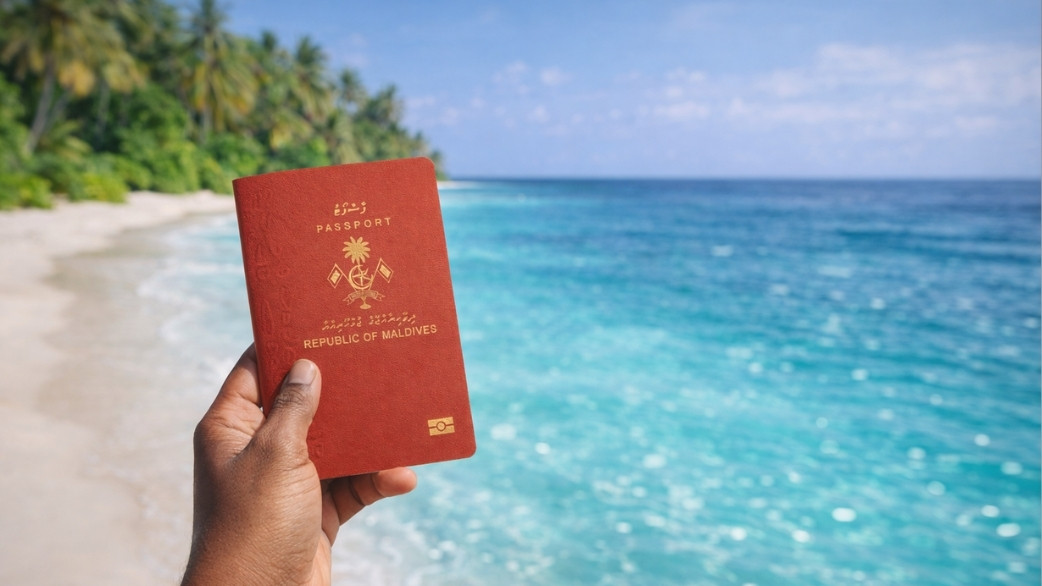



The Maldivian passport has been ranked 52nd globally in the 2026 edition of the Henley Passport Index, providing visa-free or visa-on-arrival access to 92 destinations worldwide.
The ranking places the Maldives in the middle tier globally and positions it comparatively well within South Asia. Among South Asian countries, the Maldives ranks ahead of India, which stands at 80th with access to 55 destinations, and Sri Lanka, ranked 93rd with access to 39 destinations. This gives Maldivian passport holders a broader level of global mobility than most of the region, despite the country’s small size and population.
However, the picture shifts when comparisons are drawn with Indian Ocean island states and higher-performing Asian economies. Seychelles ranks 24th globally with access to 154 destinations, while Mauritius ranks 27th with 147 destinations, both significantly outperforming the Maldives. These countries have benefited from long-standing visa liberalisation strategies and sustained diplomatic engagement aimed at improving travel access for their citizens.
Across Asia more broadly, the Maldives also trails several East and Southeast Asian passports. Malaysia ranks ninth globally with access to 180 destinations, while Singapore tops the index with access to 192 destinations. Thailand and Indonesia, ranked 60th and 64th respectively, illustrate how consistent diplomatic outreach and reciprocal visa negotiations can gradually expand passport strength over time.
The index evaluates 199 passports against 227 destinations, measuring visa-free, visa-on-arrival, and electronic travel authorisation access. While the Maldives’ current position reflects steady gains accumulated over previous years, recent rankings suggest progress has slowed, with limited expansion in visa-free access in the past year.
Notably, there has been little public indication of targeted diplomatic initiatives by the Ministry of Foreign Affairs aimed specifically at strengthening the Maldivian passport. Unlike peer countries that actively pursue visa waiver agreements as part of broader foreign policy objectives, efforts in this area appear muted, with no major new access arrangements announced in recent times.
As global mobility becomes increasingly tied to diplomatic influence, trade relations, and economic integration, the Maldives’ stable but static position points to an opportunity cost. While the passport continues to perform relatively well within South Asia, the absence of a visible, coordinated strategy to expand travel access risks leaving Maldivians behind regional peers that have treated passport strength as a policy priority rather than a passive outcome of diplomacy.