

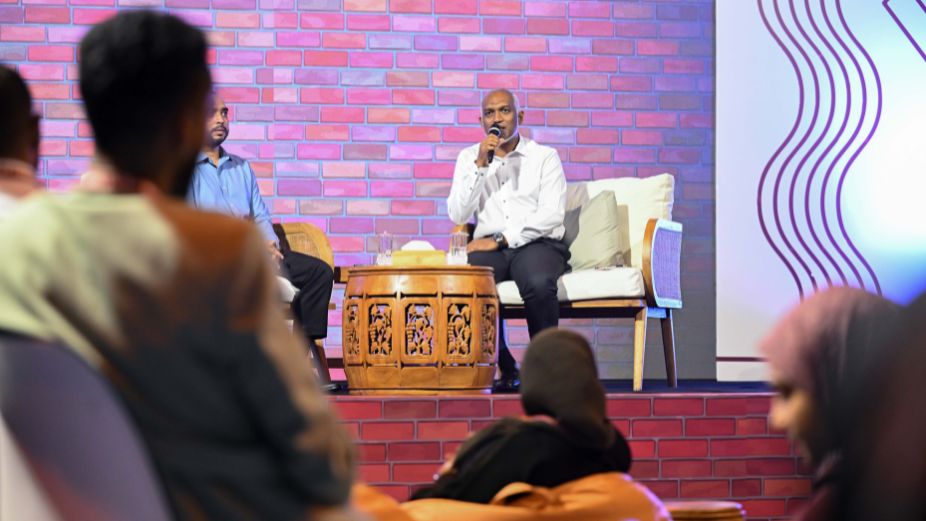



President Mohamed Muizzu has said that involving young people at every stage of decision-making is essential for long-term and sustainable national development, arguing that policies are more effective when youth perspectives are formally integrated.
The President made the remarks while speaking at the ‘Youth Coffee with the President’ session, held at the conclusion of the two-day National Youth Conference organised by the Presidential Youth Advisory Board in collaboration with the Ministry of Youth Empowerment, Information and Arts. He described young people as central to both the country’s present and its future, noting that progress depends on engaging with their views early rather than retrospectively.
During the session, representatives from six groups at the conference presented proposals covering six thematic areas, followed by discussions with the President. He later outlined the Government’s position on the issues raised and responded to the recommendations put forward by participants.
Addressing youth participation more broadly, the President said that engagement in national decision-making has historically lacked a structured framework. He noted that this gap was addressed through the creation of the Presidential Youth Advisory Board, an initiative included in his manifesto. While acknowledging challenges in its early stages, he said the Board has remained active and is expected to play a stronger role going forward.
The President also referred to concerns raised by participants regarding the relatively small number of businesses started by young people. He said reforms are being pursued to reduce barriers faced by aspiring entrepreneurs, including changes within the education system. According to the President, clearer pathways are being created for students who wish to move into business after completing their studies, with a vocational pathway now incorporated into the A-Level curriculum.
Housing was identified as a key constraint affecting youth development. The President said housing projects are being prioritised in densely populated areas and locations linked to employment opportunities, particularly in sectors such as tourism. He added that projects are being planned near home islands and in population centres close to resort areas.
He further stated that housing development is being carried out across different regions of the Maldives rather than being focused solely on the Malé area. As an example, he referred to contracts awarded around a month ago for the construction of more than 800 housing units across multiple islands, with a portion reserved for youth and those employed in sectors such as tourism and fisheries. Additional housing opportunities, he said, will also be made available in the Malé area for young people and new families.