



Climate vulnerability has emerged as a central force shaping long-term infrastructure planning in Malé City, according to the Malé City Council’s Voluntary Local Review (VLR) 2025. The report, which assesses the capital’s progress towards the United Nations Sustainable Development Goals, outlines how rising climate risks are influencing decisions on urban development, public services, and capital investment in one of the world’s lowest-lying cities.
The VLR notes that Malé faces existential threats from sea level rise, with most of the city sitting barely one metre above sea level. Based on current projections cited in the report, nearly 95 percent of the city’s land area could be at risk of flooding by 2100, placing significant constraints on how and where future development can occur. These risks, combined with extreme population density, have pushed climate resilience to the forefront of urban planning.
One of the most prominent responses highlighted in the review is the strategic shift towards land reclamation and planned urban expansion. Hulhumalé was developed as a reclaimed island elevated to around two metres above sea level, double the height of most natural islands. The report frames Hulhumalé as a climate-resilient urban hub intended to ease congestion in Malé while providing a safer platform for housing, transport networks, and public utilities over the long term.
The review also draws attention to weaknesses in Malé’s drainage and sanitation systems, many of which are more than four decades old. Frequent heavy rainfall regularly overwhelms existing infrastructure, resulting in flash flooding and damage to homes and businesses. In response, long-term planning priorities now include the modernisation of stormwater drainage, with projects such as the Maldives Urban Development and Resilience Project aimed at improving flood management and reducing climate-related displacement.
Water security features prominently in the VLR’s assessment of infrastructure vulnerability. Saltwater intrusion and pollution have rendered groundwater unusable, leaving the city almost entirely dependent on reverse osmosis desalination for drinking water. While this has ensured supply, the report notes the high energy costs involved. As a result, planners are focusing on expanding water storage capacity and piloting desalination systems powered by renewable energy to limit environmental impacts and exposure to fuel price fluctuations.
Energy demand is another area shaped by climate conditions. The VLR highlights how dense construction and limited vegetation cover, estimated at less than three percent, have intensified the urban heat island effect. Real-feel temperatures frequently reach 35 to 40 degrees Celsius, driving up electricity consumption for cooling. This has reinforced the need for grid upgrades and accelerated investment in renewable energy, including solar-linked infrastructure at sites such as Velana International Airport. The report also points to the importance of incorporating green and open spaces into urban design to reduce heat stress.
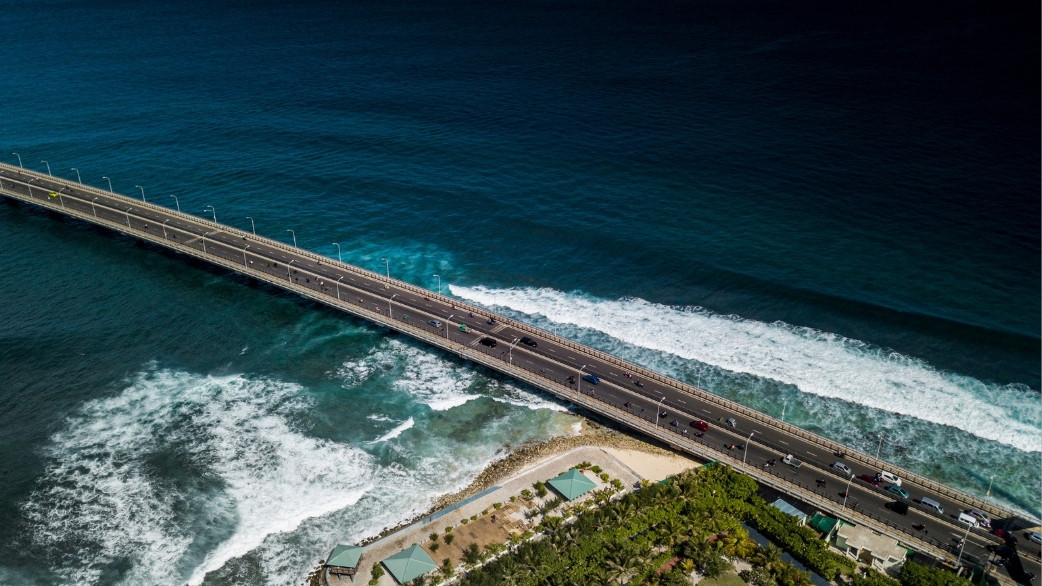
Transport connectivity is similarly framed through a climate lens. Ferry services, which remain vulnerable to rough seas and tidal conditions, are increasingly supplemented by fixed links. The VLR references infrastructure such as the Sinamalé Bridge and the ongoing Greater Malé Connectivity Project as key investments intended to ensure reliable movement between islands, support economic activity, and encourage decongestion of the most exposed and overcrowded areas.
Institutionally, the report suggests that climate vulnerability has reshaped the role of local government. The Malé City Council has moved beyond routine municipal services to take on a broader role in resilience planning. The council’s 2026 to 2030 Strategic Action Plan embeds climate resilience as a core investment pillar, alongside the development of a City Disaster Management Plan and participation in global initiatives such as Making Cities Resilient 2030. According to the VLR, these frameworks are intended to ensure that future infrastructure spending is guided by evidence-based risk assessments rather than short-term needs.
Together, the findings of the Voluntary Local Review 2025 present climate vulnerability not as a future concern, but as an immediate and defining factor in how Malé City plans its infrastructure, allocates resources, and prepares for long-term urban survival.