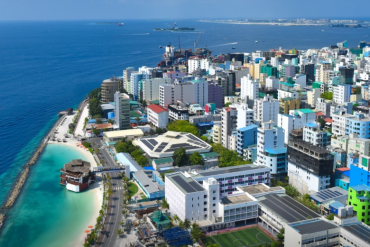
The Maldivian economy entered 2026 with stronger headline indicators, but the Maldives Monetary Authority’s Annual Report 2025 suggests that the recovery remains exposed to external shocks, fiscal pressures and the country’s continued dependence on tourism and imports.
According to the report, the economy is estimated to have expanded by 6.3 percent in 2025, up from 3.5 percent in 2024. Growth was led mainly by tourism, with fisheries, financial services, public administration and manufacturing also contributing positively. Wholesale and retail trade, however, contracted during the year, indicating that the broader recovery was uneven across sectors.







Tourism remained the main driver of economic activity. Tourist arrivals reached 2.25 million in 2025, exceeding the government’s annual target of 2.2 million and marking a 10 percent increase from the previous year. Travel receipts were estimated at USD 5.6 billion, compared with USD 4.8 billion in 2024. However, the report also noted that total tourist bednights grew by only 2 percent, while the average stay declined from 7.4 days to 7.0 days. This points to a recovery that is strong in visitor numbers, but less pronounced in length of stay.
The fisheries sector recorded a marked turnaround after a weak 2024. The sector’s gross value added is estimated to have grown by 30.8 percent in 2025, supported by higher fish purchases and a sharp increase in exports. Fish exports rose by 92 percent in volume, largely due to stronger frozen skipjack tuna exports.
Inflation also rose during the year. Average inflation accelerated to 4.0 percent in 2025 from 1.4 percent in 2024, mainly reflecting higher tobacco prices following import duty changes, as well as increases in food prices and restaurant and café costs. Lower electricity, petrol, and communication service prices helped ease some of the upward pressure.
The fiscal position improved in 2025, with the deficit narrowing to 4.1 percent of GDP from 12.1 percent in 2024. Total revenue excluding grants rose to MVR 38.9 billion, supported by higher tax and non-tax revenue, particularly from the tourism sector. However, the improvement was also linked to a sharp fall in capital spending, with expenditure on infrastructure assets and capital equipment declining. Recurrent spending continued to rise, driven by administrative expenses, subsidies, Aasandha costs, and salaries and wages.
Public debt remained high despite the improvement in the deficit. Public debt stood at MVR 134.4 billion at the end of 2025, equal to 112.6 percent of GDP. Public and publicly guaranteed debt reached MVR 154.8 billion, or 129.7 percent of GDP.
The external position improved during the year. The current account deficit narrowed to USD 476.2 million, or 6.2 percent of GDP, from USD 1.3 billion, or 17.8 percent of GDP, in 2024. This was driven mainly by stronger tourism receipts, improved fish exports and a slight decline in imports. Gross international reserves rose to USD 984.6 million by the end of 2025, compared with USD 673.9 million a year earlier.
The MMA said reserve growth was supported by stronger foreign currency inflows, foreign currency conversion requirements, higher foreign currency revenue collected by MIRA, and the USD 400 million swap facility from the Reserve Bank of India. During the year, USD 492 million was received through mandatory foreign currency conversion.
The banking sector remained resilient, with total assets growing by 17 percent to MVR 111.1 billion. Banks also recorded stronger profits, while non-performing loans as a share of total loans fell from 4 percent to 3 percent. Private sector credit grew by 13 percent, led by tourism, personal loans and construction.
The outlook for 2026 is more cautious. The MMA and the Ministry of Finance and Public Enterprises had earlier projected real GDP growth of between 4.8 percent and 5.3 percent for 2026. However, the report says downside risks have intensified due to the war in the Middle East, disruptions to flight connectivity, and higher global energy prices. Tourist arrivals fell by 21 percent year-on-year in March 2026 after strong growth in the first two months of the year.
The report also expects inflation forecasts for 2026 to be revised upward if energy price pressures persist. At the same time, fiscal risks remain elevated, including possible revenue shortfalls, refinancing pressures, and difficulties in securing external financing.
Overall, the MMA’s assessment presents 2025 as a year of stronger growth, improved reserves and a narrower external deficit. Yet the report also shows that much of the Maldives’ stability continues to depend on tourism performance, foreign currency inflows and the government’s ability to manage debt and spending pressures in a more uncertain global environment.