

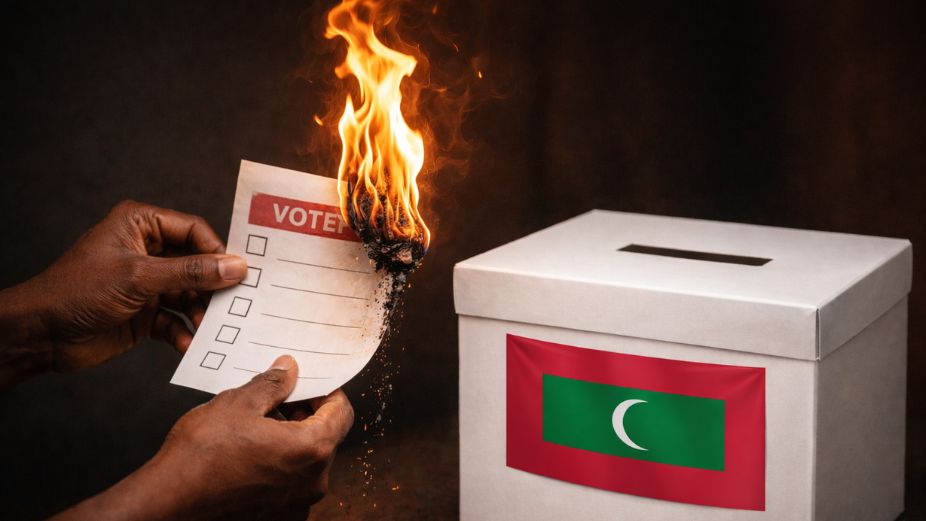



The government has been selling a deceptively simple idea: run the presidential and parliamentary elections together, save money, and spare the country the churn of back-to-back campaigns. In practice, the plan is not just an administrative tweak. It is a redesign of how Maldivians get to reward, punish, or restrain power.
The People’s Majlis has already cleared the necessary constitutional amendment with a lopsided vote, sending the final decision to the public. The referendum is scheduled for 4 April 2026, timed to coincide with local council elections, and it asks voters to approve a permanent alignment of the two national polls starting in 2028, achieved by shortening the current parliament’s term by roughly six months. Supporters frame this as a clean-up of the electoral calendar. Opponents see it as something closer to a five-year lock-in.
The government’s headline case is financial. Elections in the Maldives are expensive in ways that cannot be wished away: boats and planes, ballot distribution across widely scattered islands, security deployments, and the repeated hiring and training of temporary officials. The pro-merger argument says the state is paying twice for the same national mobilisation, and that combining the polls could cut the bill by tens of millions of rufiyaa each cycle, with proponents citing a range that reaches into the low hundreds of millions. In a debt-stressed moment, even a “small” saving becomes politically useful, because it can be presented as discipline to creditors and a public that hears, weekly, about tighter budgets and bigger repayments.
There is also a practical argument that is less cynical than either side likes to admit. Schools double as polling stations on most islands. Separate election cycles mean repeated closures, repeated disruption, repeated weeks when politics drowns out everything else. For families, teachers, and students, a single consolidated season every five years sounds like sanity. For small businesses, one period of campaign noise may be easier to tolerate than two.
But the democratic objection is not really about the transport budget. It is about timing, and how timing becomes a check.
Under the current arrangement, the presidential vote happens first, and the parliamentary vote follows months later. That gap is short, but it still functions as a second test. It forces a new president to return to voters with a record, however early, and it gives the public a chance to send a different set of representatives to the Majlis if the first months feel arrogant, chaotic, or simply disappointing. It is not a full mid-term election, but it still creates friction, and friction in a presidential system is often the difference between scrutiny and obedience.
Once you collapse the two elections into a single day, you also collapse that second test. Voters will choose a president and a parliament at the same moment, in the same emotional climate, under the same campaign narrative. The best-known political effect of this design is the “coattail” phenomenon: the presidential contest becomes the main story, and legislative candidates ride the brand of the top ticket. Voters may be pulled into straight-party voting when both ballots are cast together.
In the Maldivian context, coattails do not land on neutral ground. The parliamentary system is first-past-the-post, which tends to exaggerate seat totals even when the vote share is not overwhelming. If you then add a concurrent presidential race that dominates public attention, you increase the odds that a president begins day one with a compliant legislature, not because every MP is individually admired, but because party alignment becomes the shortcut choice. That is the heart of the fear: not that the government will win, but that it will be structurally easier for any government to win big, and then stay unbothered.
That fear gets sharper when you place the plan alongside the country’s evolving rules on party discipline. The Anti-Defection Act, ratified in 2024, sets out conditions under which elected members can lose their seats after leaving or being expelled from the party under whose ticket they were elected. The government has described this as accountability to voters, but critics have long argued it can make MPs more answerable to party leadership than to constituents. If a president’s party wins large in a combined election, and MPs face strong disincentives to break ranks, the Majlis can start to resemble an extension of the executive rather than a counterweight to it.
So what do other presidential democracies do, and what do they reveal?
The United States is the most familiar example of a built-in electoral check. Presidential and congressional elections are held together every four years, but mid-term congressional elections arrive two years later, and they reliably serve as a referendum on the president’s performance. Political scientists have documented this pattern for decades, and newer work continues to examine why the president’s party so often loses seats in mid-terms. The American design is not simply “separate elections”; it is a deliberate rhythm of accountability.
Brazil, by contrast, elects its president and legislature on the same day, and yet presidents frequently lack stable congressional majorities. The reason is not magic. It is the electoral system and the party landscape. Comparative research on concurrent elections shows that timing interacts with rules, and that the effects of concurrency vary depending on whether legislative elections are majoritarian or proportional, and how voters behave under each. Brazil’s system tends to produce fragmentation rather than sweeping majorities, forcing bargaining. The Maldives does not have Brazil’s electoral rules, its federal structure, or its tradition of legislative plurality. The comparison is useful mainly as a warning against copy-pasting reforms without the surrounding safeguards.
Mexico offers a more uncomfortable lesson for the Maldivian debate. Mexico’s 2024 election showed how a presidential victory can translate into large legislative power at the same time, raising alarms about weakened checks and balances when one movement dominates both branches. This is not an argument that concurrency always leads to dominance, but it is evidence that it can, and when it does, the consequences are constitutional, not cosmetic.
Indonesia adds another dimension: electoral design is not only about efficiency, it is also about legitimacy and the judiciary’s role in shaping rules. Debates over thresholds and electoral architecture have run through its democratic life, with courts and lawmakers repeatedly revisiting how elections should be structured. The takeaway for the Maldives is straightforward: once you shift the cycle, you are not merely saving money, you are setting a new baseline that future governments will fight over.
The government’s argument, then, is not frivolous. A country with tight finances and complicated logistics is right to examine whether it is paying too much for repeated election machinery. But the opposition’s argument is not sentimental either. Elections are not only a mechanism to select leaders. In a presidential system, they are also the most reliable instrument the public has to interrupt momentum.
That is the real question Maldivians are being asked on 4 April 2026. Not whether the state can save money by collapsing two national mobilisations into one, but whether the country is comfortable trading a recurring opportunity for correction for a cleaner calendar. If you compress the moments of judgement into a single day every five years, you should be ready to strengthen everything that is meant to carry accountability in the long months between them: oversight bodies, parliamentary committees, civil society scrutiny, and a media environment that can ask hard questions without fear.
Otherwise, the country may discover that the most expensive part of an election is not the logistics, but the accountability you do not get back once you have voted it away.