
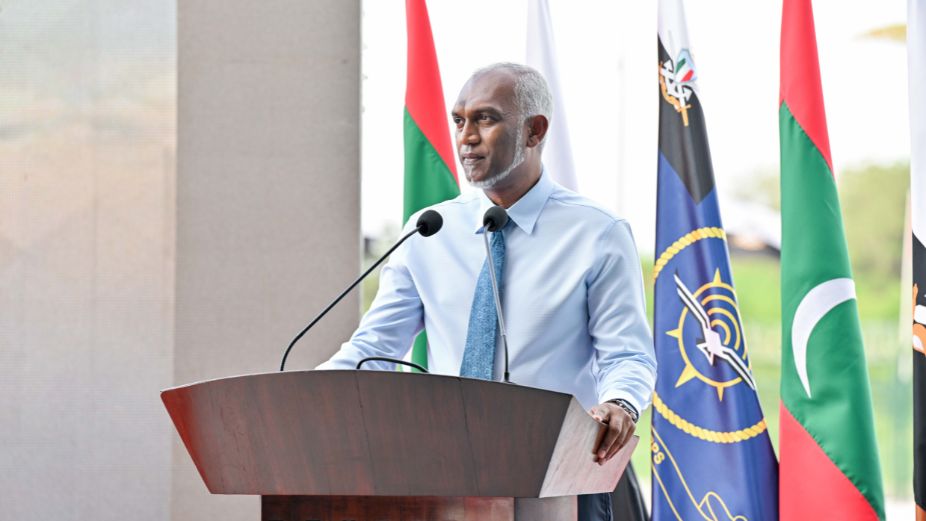



President Mohamed Muizzu has said the Maldives would be willing to allow the United States to continue operating the Diego Garcia military base if sovereignty over the Chagos Archipelago were transferred to Malé, positioning the country as an alternative claimant amid renewed international dispute over the territory.
In comments to Newsweek, President Muizzu said his administration would seek parliamentary approval to maintain existing defence arrangements should the Maldives assume control of the UK administered Indian Ocean archipelago. He framed the proposal as a way to preserve the status quo surrounding the U.S. Naval Support Facility on Diego Garcia, while addressing concerns raised in Washington about long term security.
The remarks come as the United Kingdom prepares to transfer sovereignty of the Chagos Archipelago to Mauritius under an agreement reached last year. That deal has drawn criticism from U.S. President Donald Trump, who has argued that the handover could weaken American security interests in the Indian Ocean, despite assurances from both London and Port Louis that U.S. and UK military operations would continue uninterrupted.
President Muizzu told Newsweek that the Maldives recognises the strategic importance of Diego Garcia and understands Washington’s concerns. He said that under British control, the UK and U.S. currently operate freely from the base through existing defence arrangements, including with partners such as the Maldives. Under Maldivian sovereignty, he said, the government would move to facilitate the continuation of those arrangements through constitutional processes.
Beyond security considerations, President Muizzu also advanced a broader case for Maldivian sovereignty over Chagos, pointing to geographic proximity, historical links and environmental stewardship. He noted that the islands lie roughly 310 miles from Malé and described the Maldives as having extensive experience in managing marine conservation areas alongside limited, carefully regulated development.
In the Newsweek interview, President Muizzu cited archaeological and cultural evidence to support the Maldives’ claim, including gravestones bearing Dhivehi inscriptions and historical references to Maldivian kings asserting authority over the islands centuries before Mauritius was settled. He also said genetic and cultural links between Maldivians and Chagossians should be acknowledged in any future arrangement.
The intervention places the Maldives into a complex geopolitical debate involving the UK, Mauritius and the United States, set against wider strategic competition in the Indian Ocean among major powers. While the UK maintains that international legal processes recognise Mauritius as the rightful sovereign, President Muizzu’s comments signal Malé’s interest in elevating its own historical and strategic ties to the archipelago.
President Muizzu also said that, should the Maldives’ claim progress, the interests of displaced Chagossians would need to be taken into account. He told Newsweek that the Chagossian community must have a voice in decisions over the future of the islands, acknowledging their historical links to the Maldives and their forced removal during the establishment of the Diego Garcia base.
For Corporate Maldives readers, the comments mark one of the clearest articulations yet of how the President Muizzu administration views the Chagos question, linking sovereignty claims with security assurances, environmental management and regional geopolitics.