

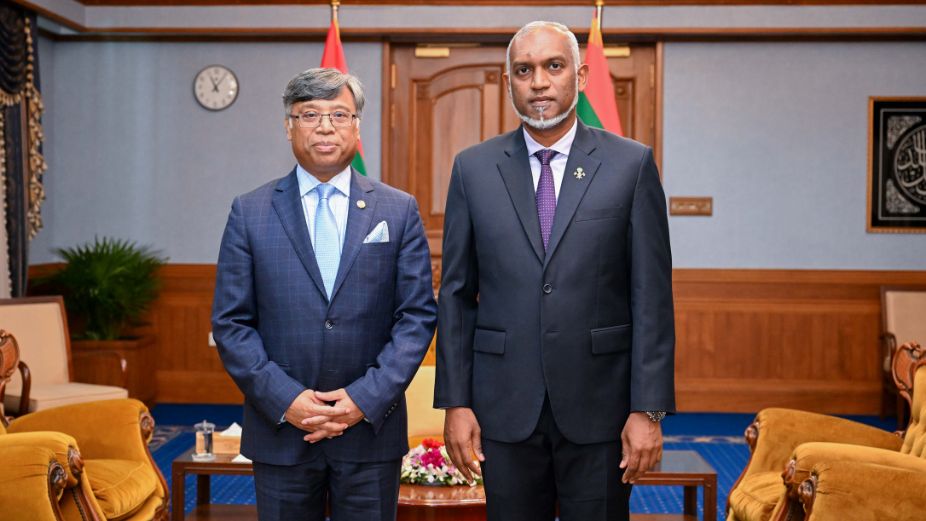



President Dr Mohamed Muizzu has issued a message to the Secretary General of the South Asian Association for Regional Cooperation on the 40th anniversary of the SAARC Charter, reiterating the Maldives’ position that meaningful regional cooperation remains essential for South Asia’s future.
In his message, the President said the moment called for reinvigorating the organisation by rebuilding trust among member states and reconvening the long-stalled SAARC Summit. He noted that dialogue, unity, and cooperation continue to be the region’s most viable route to achieving shared development goals.
The President highlighted several areas where stronger collaboration is increasingly necessary, including climate change, renewable energy, public health, food security, inequality, and broader economic development. He said a more effective institutional structure within SAARC would help the region respond to these challenges and deliver better outcomes for its populations.
President Dr Muizzu reaffirmed that the Maldives remains committed to a stronger and forward-looking SAARC, one that prioritises collective interests, upholds shared values, and contributes to long-term stability and prosperity.
SAARC was established with the signing of the SAARC Charter on 8 December 1985. The organisation was founded with the aim of promoting regional cooperation among its eight members: Afghanistan, Bangladesh, Bhutan, India, Maldives, Nepal, Pakistan, and Sri Lanka. While the grouping has facilitated cooperation in areas such as health, education, environment, and disaster response, political tensions in the region have limited its ability to convene summits and advance broader regional integration in recent years.
The President’s message comes at a time when SAARC has not held a summit since 2014. His call to rebuild trust and reconvene leaders reflects a wider concern among smaller member states about the organisation’s relevance and its capacity to address shared challenges without renewed political engagement.