

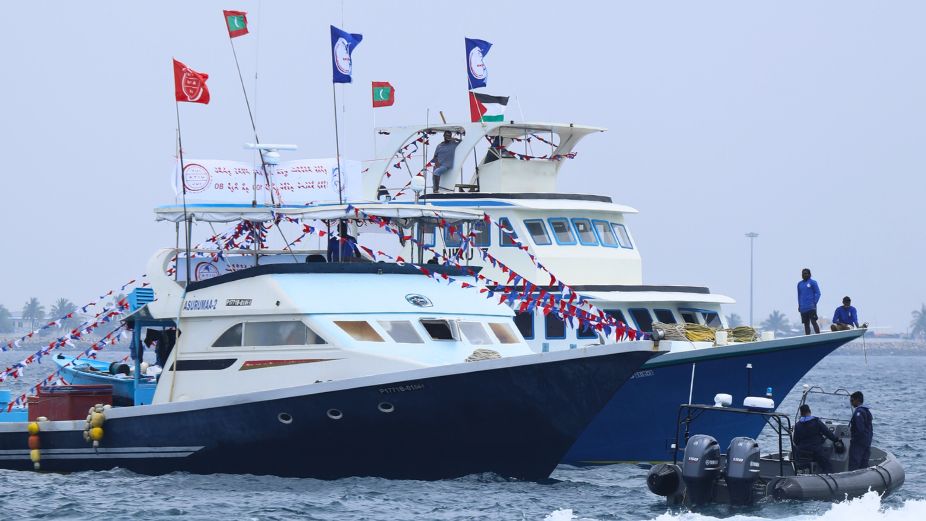



When yellowfin vessels gathered off Malé on Fishermen’s Day 2025, the scene had a familiar tension. Crews carried banners with the slogan “Dhenneh nu fureyne, dhenneh nu vaane”, and the Coast Guard positioned itself at the edge of the lagoon. The protest was rooted in three long running complaints: the lack of a state buyer for yellowfin, the call for a floor price between MVR 80 and MVR 100 per kilo, and concerns about fuel and ice costs. These points have surfaced repeatedly over the past two years, but the decision to demonstrate on Fishermen’s Day gave them a sharper political edge.
Although fisheries makes up a relatively modest share of GDP in official statistics, it remains central to exports, rural livelihoods and national identity. When fishermen choose to anchor their vessels outside Malé rather than go to sea, it signals a deeper unease within a sector that feels its concerns have not been settled.
What the administration says it has done so far
Since taking office in late 2023, the Muizzu administration has framed its fisheries policy around solving legacy issues and stabilising cash flow. Government statements throughout 2024 indicated that the arrears accumulated before the change of administration had been cleared. Officials described the backlog as significant, running into the hundreds of millions of rufiyaa, and said that disbursements had been made to fishermen. Recorded statements from the Ministry of Fisheries and MIFCO pointed to several rounds of payments that were processed within days of fish being weighed.
By early 2025, the government said that more than USD 24.9 million had been paid out under a 48 hour payment policy. Fishermen who sell to MIFCO generally agree that payments have been faster than during the years of arrears, although some have highlighted occasional delays linked to administrative processes. The broader point, however, is that the administration has staked a central part of its fisheries narrative on restoring confidence in timely payments.
In parallel, the government has spoken of strengthening MIFCO’s commercial footing. The Fisheries Minister publicly stated that he aims for MIFCO to operate without subsidies within three years, though this remains an aspiration rather than a confirmed policy pathway. There have also been references to digitising fisheries transactions and moving toward systems that track catches and payments more efficiently.
From the government’s side, these steps are described as improvements that should ease long standing frustrations. From the fishermen’s side, they are acknowledged but seen as only part of the wider picture.
Why the sector still feels under strain
Fishermen who joined this year’s protest were largely reacting to manifesto pledges they believe have stalled. Among these, the most discussed is the commitment to a state backed yellowfin purchase at a floor price. While the President did speak during the campaign about a minimum price in the range of MVR 80 to MVR 100 per kilo, this has not materialised in practice. Private processors have consistently argued that entering the yellowfin market at such a price would be financially unworkable and would distort competition. Fishermen who rely on yellowfin say that without a floor price, their income is too vulnerable to market fluctuations.
There have also been periodic concerns about fuel and ice availability. Rising operating costs mean that even a good catch can become unprofitable if input prices swing unpredictably. Fishermen say that access to fuel at base rate, which they understood to be part of the government’s direction, is still not consistent across islands. The government, for its part, has pointed to global price volatility and the fiscal implications of extensive support measures.
Another layer of tension comes from the state of the overall sector. Provisional national accounts released over the past year suggest that fisheries output has varied sharply, with some quarters showing contractions compared with previous years. Analysts note that factors such as shifting tuna stocks, reduced skipjack catch in certain seasons and global price movements have contributed. These fluctuations are reflected in fishermen’s earnings and have amplified calls for more predictable support mechanisms.
All of this sits on top of a long standing debate about MIFCO’s role. Fishermen often see MIFCO as the stabilising institution that should provide guaranteed purchasing, while private operators worry about the competitive implications of a state backed business entering markets where margins are already tight. The administration has not yet laid out detailed parameters that clarify how these roles will be balanced.
How other island states handle similar pressures
Looking across small island developing states provides useful context. None of these countries has found a perfect formula, but many have introduced structures that make their fisheries systems more predictable for both fishers and processors.
Seychelles has developed written harvest strategies and tuna management plans that incorporate regular stock assessments and formal consultation with small scale fishing groups. These documents are updated as new evidence emerges and create clearer expectations for all parties involved.
Mauritius has used targeted social protection tools to help fishermen manage volatility. These include bad weather allowances for registered fishers and compensation schemes when lagoons are closed or catches fall. The country also encourages shifts toward offshore species supported by fish aggregating devices. Its Fisheries Act includes explicit protections for small scale fishers and requires their participation in management decisions.
In the Pacific, several island nations coordinate through regional bodies to manage access to their tuna stocks. By setting collective conditions for distant water fleets, these countries secure predictable revenue streams through access fees. While the Maldives does not host the same level of distant water activity within its waters, the idea of coordinated, rules based management remains relevant.
The broader lesson is that the stability of a fisheries sector usually depends on transparent rules, defined responsibilities and predictable support mechanisms rather than ad hoc interventions.
What a workable agenda could look like
If the Maldives were to move toward a more predictable fisheries framework, several elements stand out from both local experience and international examples.
First is clarity on MIFCO’s role. Whether it is meant to function primarily as a buyer of last resort or as a commercial competitor has major implications for prices, private investment and long term fiscal exposure. A clear definition would reduce speculation and help fishermen and processors plan for the future.
Second is predictable pricing. A rules based formula for determining minimum purchase prices, linked to international market benchmarks and domestic cost indicators, would allow fishermen to anticipate income more reliably. This does not eliminate the challenges of fluctuating catch, but it reduces the uncertainty that currently drives protests.
Third is shared risk. Ensuring that all licensed buyers, not only MIFCO, adhere to strict payment timelines would shift credit risk upward in the value chain. Larger firms and financial institutions are better equipped to manage that risk than individual crews operating on thin margins.
Fourth is resilience planning. Given climate related pressures on tuna stocks, Maldives could consider a fisheries resilience fund supported by levies during strong export years. Such a fund could provide targeted assistance during seasons of low catch or high operating costs.
Finally, there is governance. The fishermen’s union has demonstrated repeatedly that it can mobilise fleets. Giving that organisation a formal seat in fisheries management would align with models seen in Seychelles and Mauritius and could reduce the need for confrontation-led communication.
The Fishermen’s Day protest did not emerge out of a single broken pledge. It reflects accumulated frustrations about incomes, purchasing arrangements, costs and the lack of clear long term direction. The government maintains that it has stabilised payments and laid the groundwork for reform. Fishermen accept some of those improvements but say the core uncertainties remain.
A sector as important as fisheries cannot be managed through statements and short term fixes. It needs a framework that considers the interests of fishermen, processors and the state, and that holds steady even when catch volumes fluctuate or global prices shift. The question after this year’s protest is whether the Maldives is ready to build that kind of long term architecture.