
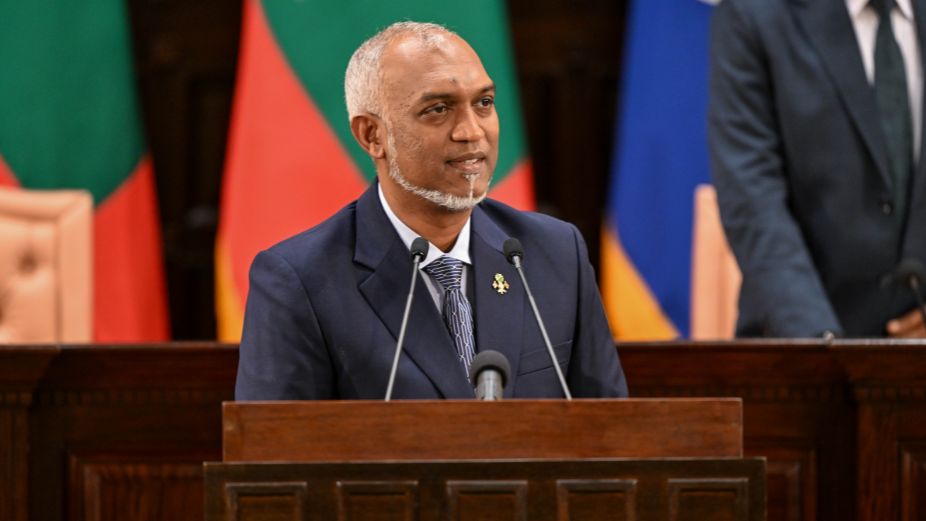


President Mohamed Muizzu inaugurated the 2026 session of the People’s Majlis with a Presidential Address outlining the Administration’s economic priorities, policy intentions, and performance claims across public finance, business conditions, infrastructure, and labour.
While the address ranged across multiple sectors, several areas carry direct implications for businesses and the broader economy. The sections below summarise key themes as presented by the President, viewed through a corporate and economic lens.
Macroeconomic Position and Public Finances
The President said the Administration remains focused on reducing inherited debt while pursuing what he described as more resilient financial outcomes. He stated that official gross reserves have surpassed USD 1.13 billion, which he characterised as the highest level recorded to date.
According to the President, state revenue and grants increased by 12 per cent in 2025 compared to the previous year. Based on current economic performance, he projected total state revenue and grants for 2026 at MVR 40.4 billion. He also said the Government has secured USD 100 million in non-tax revenue expected to be received within the next 45 days.
The President further stated that foreign currency earnings reached USD 1.2 billion in 2025 and that new foreign exchange regulations resulted in USD 492 million being exchanged through the Maldives Monetary Authority over the year.
On fiscal management, he said the 2025 budget concluded without the need for a supplementary budget, describing this as a first in five years. He added that while the average budget deficit over the previous five years exceeded 9 per cent of GDP, the 2025 deficit is projected at 5 per cent of GDP. He also stated that the budget remained in surplus for the first 40 weeks of the year.
Government Payments and Business Liquidity
Addressing payment delays, the President said the Government disbursed MVR 6.3 billion to local businesses in 2025 for goods and services provided.
He also stated that MVR 882 million was disbursed to state-owned enterprises to settle long-standing unpaid obligations, which he described as legacy bills. According to the President, an additional MVR 1 billion was paid directly to clear SOE debts. These measures were presented as efforts to ease cash flow pressures faced by businesses supplying the public sector.
SMEs and Operating Costs
The President outlined several measures intended to reduce operating costs for businesses, particularly small and medium enterprises. He said the airport clearance period for imports has been extended from 80 hours to 124 hours, demurrage fees have been waived, and storage periods at Malé and Hulhumalé ports have been increased from five days to ten days.
He announced that registration fees for small and medium cafés and restaurants will be halved for the next two years. In addition, he said companies employing fewer than 20 expatriate staff will be exempt from annual quota fees from March 2026.
The President identified the absence of a secure online payment system as a major challenge for SMEs and said this would be addressed through efforts to facilitate the introduction of PayPal.
Digital Payments and Market Access
In this context, the President highlighted the launch of Swipe, a Maldivian-developed multi-currency digital wallet introduced by Bank of Maldives. He also referred to an agreement with Alibaba, which he said would enable Maldivian businesses to access a broader export market.
According to the President, 400 vendors affiliated with Authentic Maldives have been provided with a dedicated platform on Alibaba as part of this initiative.
Access to Finance and Targeted Support
The President outlined several financing facilities aimed at addressing funding gaps in specific sectors. These include the Thijara Rashu Fathuru scheme for businesses engaged in local tourism, a vessel financing facility of up to MVR 500,000, and additional facilities of the same amount for content creators and film producers.
He said these measures are intended to expand access to finance for smaller operators and emerging industries.
Transport and Infrastructure Development
The President said establishing an integrated transport network across land, sea, and air is essential to improving mobility, facilitating trade, and supporting economic growth.
He stated that multiple airport development projects are underway and that upgrades have enabled all operational airports to facilitate night landings. He also said integrated air connectivity services using Twin Otter aircraft began on 1 February, connecting southern atolls under the Integrated Development Zone.
The President added that seaplane services are being expanded to additional regions, including the commencement of flights to N. Velidhoo. On land transport, he announced plans to procure modern equipment for the Road Development Corporation by the end of April, which he said would allow projects to be implemented more efficiently across multiple islands.
He also stated that sand roads in islands with active local tourism will be upgraded with proper drainage systems.
Tourism Policy and Revenue Distribution
The President announced plans to develop at least 10 resorts through a state-owned enterprise over the next three years. He said a portion of profits from these resorts would be distributed equally to all Maldivian citizens in foreign currency on an annual basis.
He also stated that a new law will designate every Maldivian citizen as a shareholder in these resorts, with benefits expected to begin reaching the public by 2030.
The President declared 2027 as Visit Maldives Year and said the Maldives Monetary Authority forecasts tourism revenue of USD 5.6 billion in 2026. He added that the Government aims to increase tourist arrivals to 2.5 million.
Further remarks included efforts to expand tourism, including Halal tourism, in underdeveloped atolls, and updates on tourism projects in Addu City.
Fisheries and the Blue Economy
The President said the fisheries sector had experienced prolonged neglect and that the Administration is working to restore its economic contribution. He identified limited cold storage capacity as a key constraint and said projects in eight regions are scheduled for completion within the next 15 months.
Fuel affordability was also highlighted. The President said fuel skids providing access to fuel at State Trading Organisation rates are being rolled out nationwide, following the inauguration of the first facility in R. Dhuvaafaru in December 2025.
According to the President, payments to fishermen have been processed within 48 hours since December 2024, with more than MVR 1 billion disbursed under this arrangement. He also said measures are being introduced to support the yellowfin tuna industry, including subsidised fuel and the commencement of work on a modern packing facility in Hulhumalé.
The President stated that expanding the Fish Aggregating Device network remains a policy priority and said 41 FADs were installed last year. He also highlighted the establishment of a National Register of Fishermen, stating that all active fishing vessels have been registered.
Regional Development and Addu City
The President announced a three-year programme beginning in 2027 to support small and medium enterprises in Addu City, including special concessions and designated business areas. He said the initiative is intended to stimulate employment and position Addu as a future IT hub.
He also reaffirmed that the relocation of the commercial harbour to Thilafushi will be completed by November 2027, which he said would reduce cargo unloading times and ease storage pressures in Malé.
Labour Market and Employment
On employment, the President said policies implemented since November 2023 have resulted in the creation of 21,174 job opportunities, including 6,724 in the private sector. He stated that at least 25,000 additional jobs are expected over the next year.
He also announced that, effective from February 2027, only Maldivians will be permitted to work as cashiers. Addressing expatriate labour, the President said 11,496 undocumented expatriates have been repatriated since November 2023 and that operations to resolve the issue permanently will conclude by May 2027.