

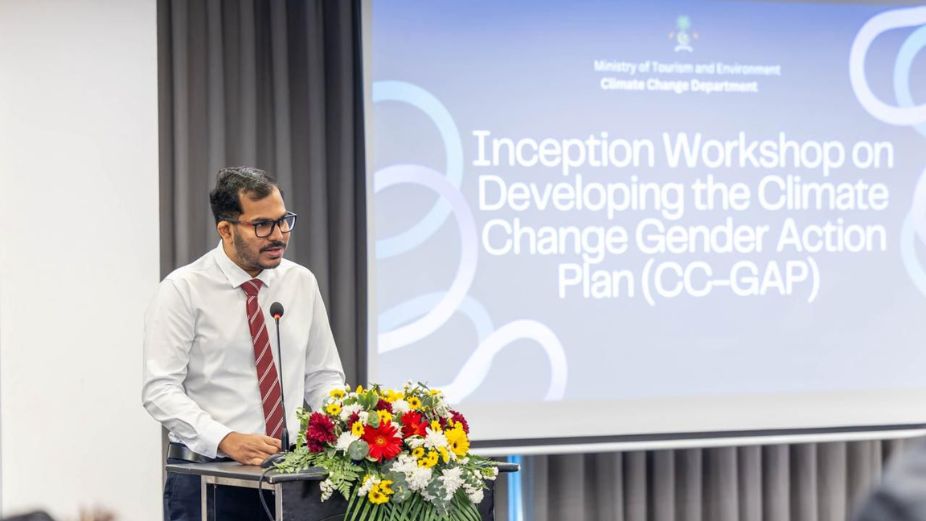




The Maldives has begun the process of developing its first Climate Change Gender Action Plan, marking a policy step towards integrating gender considerations into national climate planning and implementation.
The initiative was formally launched through an inception workshop organised by the Ministry of Tourism and Environment in collaboration with the Ministry of Social and Family Development. The workshop, held on 26 January, brought together representatives from government institutions, academia, civil society organisations, and international development partners.
Participants included officials from the President’s Office, the Ministry of Foreign Affairs, the Ministry of Finance and Planning, the Ministry of Education, and the Maldives Meteorological Service, alongside representatives from The Maldives National University, Islamic University of Maldives, local non-governmental organisations, and UN agencies such as UNDP and UNICEF.
Opening the workshop, Minister of State for Tourism and Environment Ibrahim Mimrah highlighted that climate change impacts are being felt unevenly across sectors such as health, infrastructure, disaster risk reduction, and livelihoods, with existing gender disparities shaping exposure and resilience. He also noted that while women and marginalised groups possess important knowledge and leadership capacity, these contributions are not always fully reflected in climate policy design and implementation.
Although gender-related actions have previously been referenced in the Maldives’ third Nationally Determined Contributions, the Climate Change Gender Action Plan represents the first framework developed with a specific focus on gender equity within climate adaptation and mitigation efforts.
According to the Climate Change Department of the Ministry, the plan is intended to provide a structured approach to embedding gender perspectives across climate policy formulation, implementation, and monitoring. During the workshop, participants examined sector-specific vulnerabilities and policy gaps, and contributed to discussions on identifying and prioritising gender-responsive climate actions.
The Climate Change Gender Action Plan is being developed by the Climate Change Department of the Ministry of Tourism and Environment, with technical support from the NAP Global Network.