





The government has moved to reassure markets and the public that supply chains for essential commodities remain stable, even as geopolitical tensions in the Middle East continue to disrupt global trade flows.
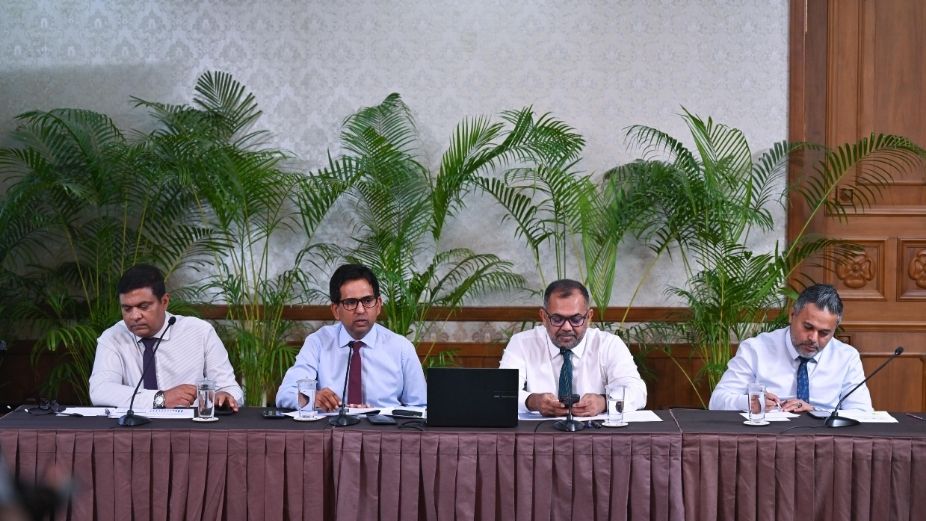
At a press briefing held at the President’s Office yesterday, the Special Cabinet Committee established to monitor the situation stated that contingency measures have been put in place to prevent shortages and maintain economic stability. The Committee indicated that efforts to diversify import sources are already underway, with alternative supply routes secured through countries including China, India, Türkiye and ASEAN member states.
Minister of Economic Development, Transport and Trade Mohamed Saeed said coordination with the Ministry of Foreign Affairs and other stakeholders had enabled the identification of new sourcing channels shortly after tensions escalated. These adjustments, he said, are intended to strengthen supply chain resilience and reduce exposure to disruptions in traditional trade routes.
Fuel availability remains a central concern given volatility in global oil markets. Minister of Finance and Public Enterprises Moosa Zameer, who chairs the Committee, said arrangements have been finalised to ensure continued access to fuel for both households and businesses. The assurance comes as many countries face rising costs and supply uncertainties linked to the regional conflict.
Support measures have also been extended to key sectors. Minister of Fisheries, Agriculture and Marine Resources Ahmed Shiyam noted that over 1.1 million litres of fuel have already been distributed to fishermen at concessional rates, reflecting an effort to maintain operations in a sector sensitive to input costs.
The Committee further outlined financial interventions aimed at cushioning the domestic economy. Assistance facilitated through the Bank of Maldives includes expanded access to capital and trade finance, alongside measures designed to stabilise commodity prices. These interventions are expected to support business continuity and mitigate the impact of external shocks.
At the same time, the government signalled that fiscal adjustments are underway. State-owned enterprises have been instructed to implement staffing changes as part of broader expenditure rationalisation efforts. The Committee stated that these measures will be carried out in accordance with existing legal and regulatory frameworks.
Updates were also provided on sector-specific support, covering tourism, fisheries, aviation, agriculture and small and medium-sized enterprises, with the aim of maintaining uninterrupted operations across the economy.
On public sector reforms, the Committee said around 7 per cent of the government’s pay harmonisation programme remains incomplete, with instructions issued to expedite the remaining adjustments.
The Special Cabinet Committee was formed in late February in response to the evolving situation in the Middle East and was reconstituted in mid-April following recent cabinet changes. The latest briefing marks its first update since the reconstitution, signalling a renewed focus on managing external risks to the Maldivian economy.