- The government proposed a MVR 59.7 billion budget for 2027, reducing overall spending by MVR 4.5 billion while prioritising housing, healthcare and infrastructure.
- No new taxes are planned, though the GST registration threshold will rise to MVR 1.5 million, with revenue growth focused on improved tax administration.
- Major projects include relocating Malé Commercial Port to Thilafushi, completing the Thilamalé Bridge, boosting tourism, and expanding renewable energy capacity by 2027-2028.
The government has proposed reducing its overall budget by MVR 4.5 billion in 2027, while allocating funding for housing, healthcare and major infrastructure projects.
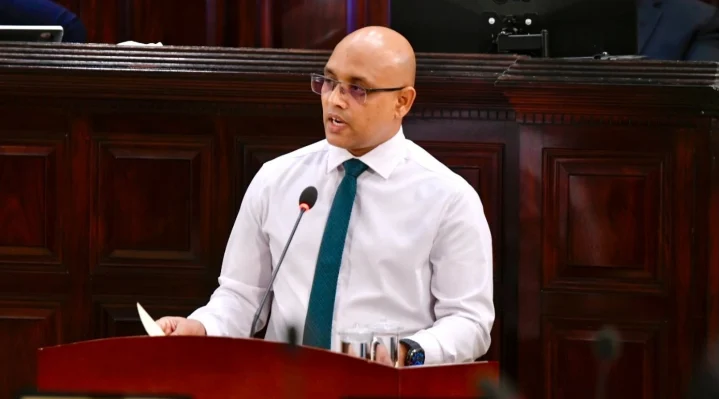
Minister of Finance and Public Enterprises Hassan Zareer presented the MVR 59.7 billion budget to the People’s Majlis today. He said the proposal was intended to maintain public services and support development while strengthening fiscal and debt sustainability.






Total expenditure is projected at MVR 52.6 billion, comprising MVR 42.7 billion in recurrent expenditure and MVR 9.9 billion in capital expenditure. Recurrent spending, which covers the government’s operating costs, accounts for more than four-fifths of projected expenditure. The Public Sector Investment Programme (PSIP) has been allocated MVR 8.2 billion for development projects.
State revenue is estimated at MVR 43.2 billion. The government does not plan to introduce new taxes next year, with efforts to increase collections instead focusing on improvements to tax administration.
The proposed measures include raising the Goods and Services Tax (GST) registration threshold from MVR 1 million to MVR 1.5 million from 1 January 2027, increasing the turnover level at which businesses must register.
Housing allocations include MVR 3 billion for development projects and MVR 750 million in equity funding for housing loan schemes supporting the purchase or construction of homes.
The health sector has been allocated MVR 10.2 billion. Education provisions include MVR 136.3 million for the free degree programme and MVR 651 million for higher education loan facilities.
Among the major infrastructure projects outlined in the budget presentation is the relocation of Malé Commercial Port to Thilafushi. Physical work is underway, with the government targeting completion and commencement of operations by 11 November 2027.
The new port is being developed across 60 hectares with a 1.4-kilometre quay wall, compared with the existing Malé port’s five-hectare site and 101-metre quay wall. The government expects the relocation to increase cargo handling capacity, reduce cargo clearance waiting times from between nine and 14 days to fewer than three days, and ease congestion in Malé.
The Greater Malé Connectivity Project, also known as the Thilamalé Bridge, is scheduled for completion and commissioning by the end of 2027. The connection forms part of the government’s plans to improve transport and commercial links across the region.
Tourism plans centre on attracting 2.5 million visitors during 2027, which has been designated Visit Maldives Year.
The government also outlined the Maldives Solar Development and Energy Storage Solutions Project, which would establish 250 megawatts of renewable energy capacity alongside storage systems. The project is intended to support the target of generating 33 per cent of the country’s electricity from renewable sources by 2028.
The government estimates that the project would reduce annual fuel imports by between 120 million and 130 million litres, lowering fuel expenditure and subsidy requirements.
For fisheries, plans for 2027 include an additional 11,400 tonnes of storage capacity, 550 tonnes of daily ice production capacity and a bigeye tuna packing facility in Hulhumalé.
Minister Zareer linked the proposed budget to President Dr Mohamed Muizzu’s objective of transforming the Maldives into a developed nation by 2040, saying it sought to advance development while maintaining macroeconomic stability.