India’s National Security Adviser Calls for Closer Indian Ocean Security Cooperation
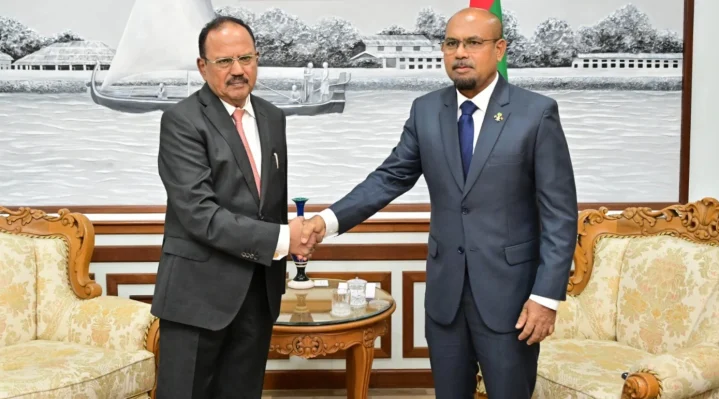
- India's National Security Adviser Ajit Doval urged stronger security cooperation among Indian Ocean nations at the eighth Colombo Security Conclave meeting in Malé.
- The CSC, involving six nations, covers five areas including maritime security, counter-terrorism, anti-trafficking, cybersecurity and disaster relief, with a new Secretariat in Colombo.
- Doval linked the grouping to India's Neighbourhood First policy and MAHASAGAR vision, and separately met Maldivian Defence Minister Hassan Rasheed on bilateral cooperation.
India’s National Security Adviser Ajit Doval has called for stronger cooperation among Indian Ocean countries to address shared security threats, telling regional counterparts meeting in Malé that their common maritime space should bring nations together.
Doval was addressing the eighth National Security Adviser-level meeting of the Colombo Security Conclave (CSC) on Wednesday, 25 November. The meeting runs from 24 to 26 November and brings together representatives from the Maldives, India, Sri Lanka, Mauritius, Bangladesh and Seychelles.







He said the region’s historical and cultural connections provided a foundation for cooperation on maritime security, economic prosperity and regional stability. Referring to remarks by Maldivian National Security Adviser Ibrahim Latheef, Doval urged participating countries to preserve the connections created by the seas for future generations.
Doval reaffirmed India’s commitment to helping member countries strengthen their collective capacity to respond to evolving security challenges. He linked the CSC to India’s Neighbourhood First policy and its MAHASAGAR vision, which guides broader cooperation on security and growth.
MAHASAGAR, short for Mutual and Holistic Advancement for Security and Growth Across Regions, was introduced in 2025. It expanded upon India’s earlier SAGAR approach to include partnerships across the wider Global South.
The CSC developed from maritime security talks between the Maldives, India and Sri Lanka that began in 2011. The framework was broadened in November 2020, extending cooperation beyond its original maritime focus.
Its five areas of cooperation now cover maritime safety and security; countering terrorism and radicalisation; combating trafficking and transnational organised crime; cybersecurity and protection of critical infrastructure and technology; and humanitarian assistance and disaster relief.
Doval also pointed to progress in establishing the grouping’s institutional framework. India, the Maldives, Mauritius and Sri Lanka signed the CSC Charter and a memorandum of understanding to establish its Secretariat in Colombo on 30 August 2024. The organisation now has a Secretariat and a Secretary General to support its work.
The Malé meeting follows a virtual deputy national security adviser-level meeting hosted by India in September. Participants reviewed the CSC’s cooperation roadmap for 2025–2026 and progress in training and capacity-building programmes. They also reaffirmed the importance of coordinated responses to regional emergencies and disasters.
Separately, Doval met Minister of Defence and National Service Hassan Rasheed on Tuesday, 24 November. The two sides discussed strengthening bilateral defence and security cooperation and exchanged views on matters of mutual interest, according to statements from the Indian High Commission and the Maldivian ministry.