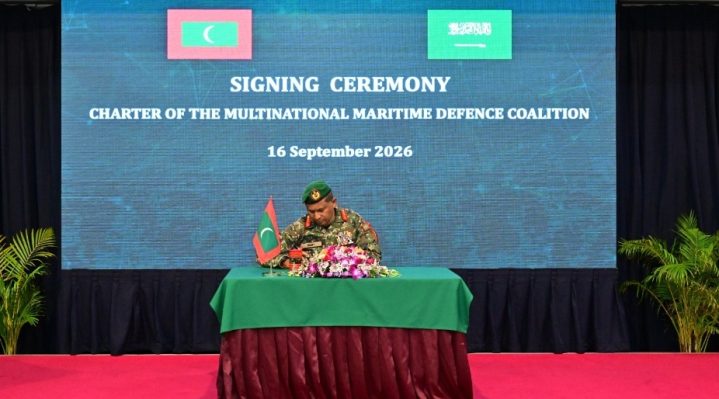
The Maldives has formalised its membership in a Saudi-led maritime defence coalition established to protect navigation and commercial shipping across the Red Sea, the Bab el-Mandeb Strait and the Gulf of Aden.
Chief of Defence Force Major General Ibrahim Hilmy signed the charter of the Multinational Maritime Defense Alliance on behalf of the Maldives on Wednesday. Foreign Minister Dr Iruthisham Adam witnessed the signing.







The ceremony completed the country’s accession after the People’s Majlis approved membership in August. The announcements surrounding the signing did not specify whether the Maldives would contribute military personnel, vessels or aircraft to the coalition.
Saudi Arabia announced the alliance on 30 July following an international meeting in Riyadh attended by representatives from 43 countries and the European Union.
Saudi Arabia and 13 other countries initially supported the alliance’s establishment. The other founding participants were reported as Turkiye, Kuwait, Bahrain, Qatar, Jordan, Egypt, Pakistan, Djibouti, Somalia, Bangladesh, Yemen, Sudan and the Comoros.
Saudi Arabia serves as the alliance’s founding and leading state, while its permanent headquarters will be based in the country.
The coalition is intended to provide a framework for intelligence and information sharing, operational planning, joint exercises and coordinated maritime operations. Saudi authorities have described it as a defensive arrangement that does not target any particular country.
Its area of focus covers a continuous maritime corridor linking the Indian Ocean with the Mediterranean Sea through the Gulf of Aden, Bab el-Mandeb, Red Sea and Suez Canal. The route supports major flows of consumer goods, commodities and energy between Asia, the Middle East and Europe.
An estimated 10 to 12 percent of global maritime trade passes through the Bab el-Mandeb Strait, including millions of barrels of oil each day. The waterway is approximately 29 kilometres wide at its narrowest point, leaving international shipping particularly exposed to conflict or disruption.
The alliance was formed amid increased attacks on commercial shipping and energy infrastructure by Yemen’s Iran-aligned Houthi forces. Disruption in the area has forced some shipping companies to divert vessels around southern Africa, increasing journey times, freight expenditure and insurance costs.
For an import-dependent economy such as the Maldives, instability along international shipping and energy routes can translate into higher transport costs and greater pressure on fuel and commodity prices, even when the disruption occurs outside Maldivian waters.
The new coalition will operate alongside other security initiatives already active in the region. These include the European Union’s Operation Aspides, which was launched in 2024 to protect commercial vessels and support freedom of navigation in the Red Sea.
Saudi authorities have not yet provided detailed information on how the new alliance will coordinate with existing maritime missions or how operational responsibilities will be divided among its members.
The Maldives’ participation places the country within a wider security framework extending beyond its immediate Indian Ocean neighbourhood. However, the practical extent of its commitments will depend on the alliance’s operational arrangements and any contributions agreed by the Government and the Maldives National Defence Force.