
- MFLC has become the Maldives' first National Direct Access Entity accredited to the Green Climate Fund.
- The accreditation was approved at the 46th GCF Board meeting held in Songdo, Republic of Korea.
- MFLC can now submit funding proposals directly to the GCF, bringing climate finance closer to local priorities.
The company’s recognition as the Maldives’ first National Direct Access Entity could help bring international climate finance closer to local businesses, communities and national priorities.
For the Maldives, climate finance is not an abstract policy issue. It is closely tied to the country’s economic resilience, energy security, water resources, transport systems and the long-term sustainability of its island communities.







Against this backdrop, Maldives Finance and Leasing Company Pvt Ltd (MFLC) has achieved a significant milestone by becoming the Maldives’ first National Direct Access Entity accredited to the Green Climate Fund (GCF).

Photo: GCF / 46th meeting of the GCF Board
The accreditation was approved during the 46th meeting of the GCF Board, held from 26 to 29 October 2026 in Songdo, Incheon, Republic of Korea. It places MFLC among the national institutions able to work directly with the world’s largest dedicated climate fund to develop and submit proposals for climate-related projects and programmes.
For the Maldives, the significance of the accreditation extends beyond MFLC itself. It represents a strengthening of national capacity to access international climate finance and creates a platform for locally developed solutions to be connected with global funding opportunities.
Bringing climate finance closer to national priorities
The Green Climate Fund was established to support developing countries in transitioning towards low-emission and climate-resilient development. Through its Accredited Entities, the Fund supports projects that reduce greenhouse gas emissions and strengthen resilience to the impacts of climate change.
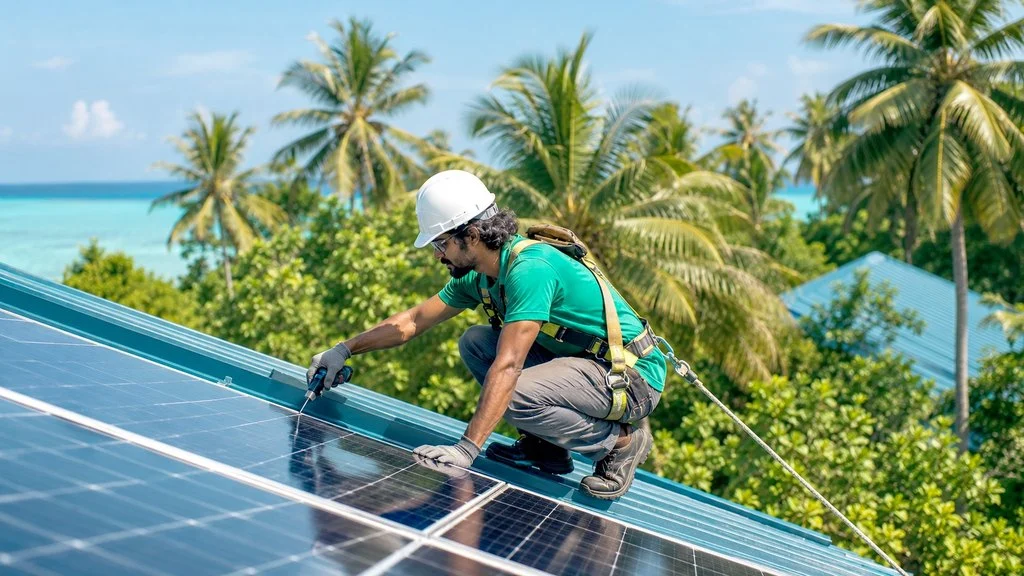
As a National Direct Access Entity, MFLC will be able to develop and submit funding proposals directly to the GCF, subject to the Fund’s requirements and project-specific approval processes.
This means that climate finance initiatives can be developed with a closer understanding of the Maldives’ economic structure, geographic realities and development priorities. It also creates opportunities for stronger collaboration between government institutions, private businesses, financial institutions and international development partners.
For a country made up of dispersed islands and facing high costs associated with infrastructure, transport and energy, the ability to develop financing solutions that reflect local conditions is particularly important.
A milestone built on institutional capacity
MFLC’s accreditation follows a comprehensive assessment of its financial management, fiduciary standards, governance, risk management, environmental and social safeguards, and gender considerations.
The process required the Company to strengthen and demonstrate the systems, policies and procedures necessary to meet internationally recognised standards.
According to Ms. Ibthishama Ahmed Saeed, Managing Director and Chief Executive Officer of MFLC, the accreditation reflects years of institutional development and the commitment of the Company’s Board, management and employees.

“This is a proud achievement for MFLC and an important milestone for the Maldives,” she said. “It reflects the considerable effort and commitment of our Board, management and employees in strengthening our institutional capabilities and meeting the standards required by the Green Climate Fund.”
She added that the accreditation journey was undertaken through MFLC’s internal resources and without relying on external consultancy support.
“This demonstrates the depth of our institutional capacity and our ability to develop and maintain policies, systems and procedures that meet internationally recognised standards,” she said.
That internal ownership is an important aspect of the achievement. Accreditation is not simply a designation; it requires an institution to demonstrate that it has the governance, controls and safeguards needed to manage climate finance responsibly.
From green financing to climate investment
MFLC’s accreditation builds on the Company’s existing focus on sustainable finance.
Since introducing its Green Loan and Lease financing programme in 2022, MFLC has supported investments in areas including renewable energy, energy-efficient technologies, sustainable transportation and environmentally responsible business activities.

The GCF accreditation provides an opportunity to expand this work. MFLC intends to explore climate financing programmes across sectors such as renewable energy, sustainable maritime transport, energy efficiency and water security.
These areas are closely connected to the Maldives’ development challenges. The country’s reliance on imported fuel, the cost of electricity generation, the need for more efficient transport and the vulnerability of freshwater resources all point to the importance of investment that can reduce emissions while strengthening resilience.
For businesses, access to suitable financing can often be a major barrier to adopting cleaner technologies. Energy-efficient equipment, renewable energy systems and sustainable transport solutions may require significant upfront investment, even when they offer long-term savings.
MFLC’s role as a National Direct Access Entity could help create financing structures that make such investments more accessible to businesses and other project developers.
The next challenge: building a strong project pipeline
While accreditation is a major achievement, it is also the beginning of a longer process. MFLC’s immediate priority will be to work with the Government, businesses and development partners to identify viable climate projects and develop a strong pipeline capable of attracting international financing.
This will require more than identifying projects with environmental benefits. Future proposals will need to demonstrate clear development impact, sound financial
structures, strong implementation arrangements and compliance with the GCF’s environmental, social and gender requirements.

The quality of the project pipeline will therefore be central to the success of MFLC’s accreditation.
Potential projects may involve renewable energy systems, energy efficiency improvements, low-emission transport, climate-resilient infrastructure, water security and other investments that contribute to national mitigation and adaptation priorities.
Developing these projects will require close coordination among public institutions, private sector stakeholders, technical partners and communities. It will also require project developers to build the capacity needed to prepare proposals that meet international climate finance standards.
A broader role for the financial sector
MFLC’s accreditation also highlights the evolving role of financial institutions in the Maldives’ climate response.
Traditionally, climate action has often been associated with government policy and development assistance. However, the scale of investment required to transition towards a more sustainable and resilient economy means that financial institutions will play an increasingly important role.
Banks, leasing companies and other financial institutions can help channel capital towards climate-positive investments, develop new financing products and support businesses as they manage the risks and opportunities associated with the transition to a low-emission economy.
For MFLC, the GCF accreditation strengthens its ability to participate in this process at both the national and international levels.
It also reinforces the importance of governance, risk management and responsible financing practices in supporting sustainable development.
A national opportunity
The Maldives faces significant challenges as a small island developing state. Climate impacts are compounded by geographic dispersion, limited land availability, high infrastructure costs and dependence on imported goods and fuel.
At the same time, the country has opportunities to pursue cleaner energy, more efficient transport, sustainable tourism, improved water security and climate-resilient infrastructure.
Access to international climate finance can help bridge the gap between these opportunities and the resources required to realise them.
MFLC’s accreditation does not guarantee funding for individual projects, and all proposals will remain subject to the GCF’s approval processes. However, it provides a new institutional channel through which Maldivian priorities can be developed into internationally supported climate investments.
It also gives local stakeholders a national partner with an understanding of the Maldivian business environment and the requirements of international climate finance.

Looking ahead
MFLC will continue engaging with relevant government authorities, the GCF Secretariat and prospective development partners to identify priority areas, develop a credible project pipeline and strengthen the arrangements needed to implement future GCF-supported programmes.
For Ms. Ibthishama, the significance of the accreditation will ultimately be measured by its impact.
“While we are proud of this achievement, we recognise that accreditation is only the beginning,” she said. “The real measure of our success will be our ability to translate this opportunity into meaningful investments that benefit the Maldives.”
That focus on implementation will be critical. The value of MFLC’s accreditation will not be determined solely by its status, but by the projects it helps bring forward, the businesses and communities those projects support, and the contribution they make to a more sustainable and climate-resilient Maldives.
For the country’s climate finance landscape, MFLC’s recognition marks an important step. It strengthens national ownership, expands the role of local financial institutions and creates new possibilities for connecting Maldivian priorities with international resources.
As the Maldives continues to navigate the economic and environmental pressures of climate change, the ability to mobilise finance locally and internationally will remain central to its development future.