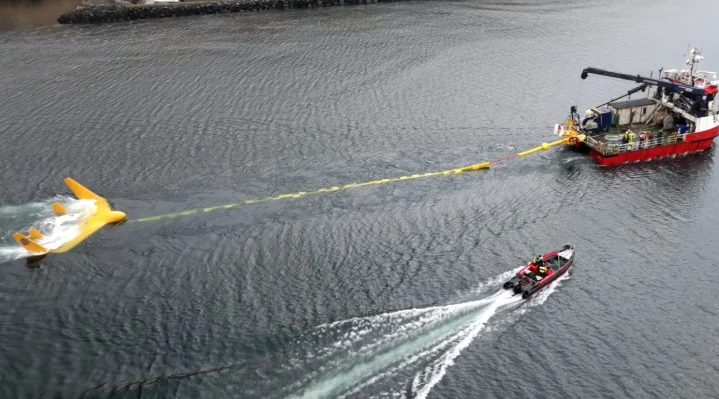
- Minesto and Morteza Capital signed a memorandum of understanding to pursue commercial tidal power projects in the Maldives, with site and capacity undisclosed.
- Minesto's Dragon kite, tethered to the seabed, generates electricity from currents even after dark, though output varies with current strength.
- The deal supports the Maldives' goal of 33 per cent renewables by 2028 and reducing USD 443.6 million in annual diesel imports.
Minesto and Morteza Capital are exploring whether underwater kites could generate enough electricity to cut diesel use on Maldivian islands. The Swedish marine energy developer and the investment firm signed a memorandum of understanding to pursue commercial tidal power projects, with a site, generating capacity and construction timetable still to be disclosed.
Under the agreement announced on 26 October, Minesto will provide the technology and engineering expertise, while Morteza Capital will help develop projects and structure investment. Minesto said it had secured support from the Nordic Project Fund for preparatory work in the Maldives.







The kite, called Dragon, is tethered to the seabed. As the current carries it through a figure of eight, the kite moves faster than the water around it. That increases the flow through its turbine, allowing it to generate electricity in slower currents. A cable carries the power to shore. The kite can generate after dark, when solar panels are idle, although its output varies as currents strengthen and weaken.
The technology has supplied electricity to the grid in the Faroe Islands. Minesto’s 1.2-megawatt Dragon 12 first delivered power there in 2024. The company brought it ashore for inspection and maintenance in March 2026 after a later deployment of about 10 months. In August, Minesto published a two-week sample for its smaller, upgraded Dragon 4. The chart shows daily output ranging from roughly 200 to 500 kilowatt-hours, illustrating how much electricity production can vary at the same site.
That variation matters in the Maldives. A 2011 study cited in the national energy roadmap modelled currents in channels around North and South Malé Atolls. It estimated about 106 megawatts of extractable power when the open-ocean current flowed from east to west and 28 megawatts when it flowed in the opposite direction, using average current speeds for each direction. In 2023, the government sought measurements at four sites in Kaafu Atoll, plus a longer deployment at one site to capture seasonal changes.
The government has also planned a separate 100-kilowatt pilot for wave or current power under an Asian Development Bank-backed programme. Both efforts come as the Maldives works towards meeting 33 per cent of its electricity demand from renewables by 2028. President Dr Mohamed Muizzu told Parliament in February that the country spends an average of USD 443.6 million a year on diesel imports, mostly for power generation.
For an island utility or resort, the test is how much diesel a kite can save over a full year. That depends on when it produces electricity, how much of that power the local grid can use, and whether the fuel savings cover the cost of installing, connecting and servicing the equipment.