- President Muizzu established a seven-member commission under Presidential Decree No. 2026/17 to investigate the Maldives' handling of its ITLOS maritime boundary dispute with Mauritius.
- International experts concluded the Maldives' actions caused substantial, irreversible losses to fisheries, marine wealth and seabed resources, prompting the inquiry into possible legal negligence.
- The commission, chaired by Uz Ahmed Shakir, will examine officials' decisions, document preservation, assign accountability, and propose reforms to prevent similar problems.
Decisions taken by Maldivian officials and advisers during the country’s maritime boundary dispute with Mauritius will face a presidential inquiry, with a newly established commission tasked with examining possible legal negligence and identifying those who should be held accountable.
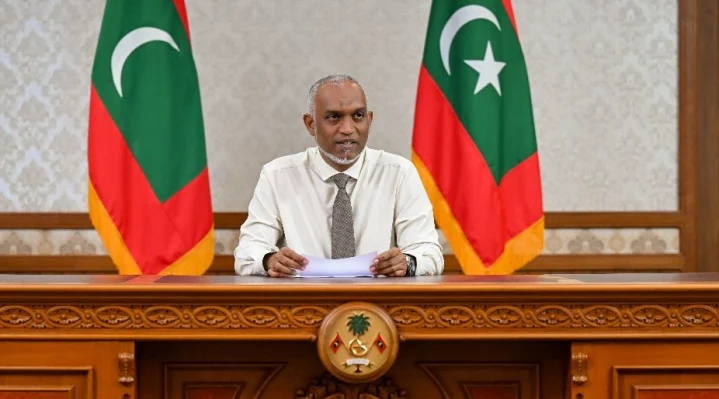
President Dr Mohamed Muizzu established the seven-member commission under Presidential Decree No. 2026/17, exercising his powers under Article 115(o) of the Constitution. Its formation follows his announcement during the Presidential Address on 5 February that an inquiry would be conducted into the Maldives’ handling of the case.







The investigation concerns Case Number 28 at the International Tribunal for the Law of the Sea (ITLOS), which addressed overlapping maritime claims between the Maldives and Mauritius in the waters between the Maldives and the Chagos Archipelago.
The President’s Office said international experts appointed to review the case and assess possible next steps had concluded that actions taken by the Maldives resulted in substantial and irreversible losses affecting fisheries, marine wealth and seabed resources. These are the government’s stated grounds for establishing the inquiry.
The commission’s remit extends across the decisions preceding the case’s submission, the conduct of proceedings, the Maldives’ legal responses and related matters. It will examine the actions of state employees, advisers, officials and other authorities involved directly or indirectly in the case.
It must determine whether legal negligence occurred and establish its nature and extent. The inquiry will also examine how documents relating to the proceedings were maintained and preserved.
Alongside identifying appropriate measures against those it considers responsible, the commission will propose changes to the organisation and management of state affairs to prevent similar problems.
Uz Ahmed Shakir (ODRDD) will chair the commission. Its other members are Abdul Azeez Yoosuf, Dr Aminath Shafiya Adam, Dr Abdul Muhsin Mohamed, retired Deputy Commissioner of Police Mohamed Sadiq, Ahmed Ali Maniku and Uza Fathimath Minhath Izzath.
The dispute entered international proceedings in June 2019, when Mauritius initiated arbitration under the United Nations Convention on the Law of the Sea. Both countries subsequently agreed in September 2019 to transfer the proceedings to a special chamber of ITLOS.
The Maldives challenged the chamber’s jurisdiction, including on grounds connected to the dispute between Mauritius and the United Kingdom over Chagos. In January 2021, the chamber rejected the preliminary objections and concluded that Mauritius could be treated as the coastal state for the purpose of delimiting the maritime boundary.
The chamber delivered its boundary judgment on 28 April 2023. Within the relevant area of overlapping maritime entitlements, the line allocated 47,232 square kilometres to the Maldives and 45,331 square kilometres to Mauritius.
The ruling concerned the delimitation of exclusive economic zones and continental shelves. Those allocations therefore describe the division of overlapping maritime entitlements, rather than establishing that the entire area allocated to Mauritius had previously been recognised as Maldivian territory.
The chamber also declined to delimit the continental shelf beyond 200 nautical miles because it could not determine Mauritius’ entitlement in the area concerned.
The commission will examine how the Maldives conducted the case and whether officials fulfilled their legal responsibilities. It has no fixed completion date and will remain operational until President Muizzu declares its mandate fulfilled.