President Muizzu Urges Shift in Global Investment Narrative Around SIDS
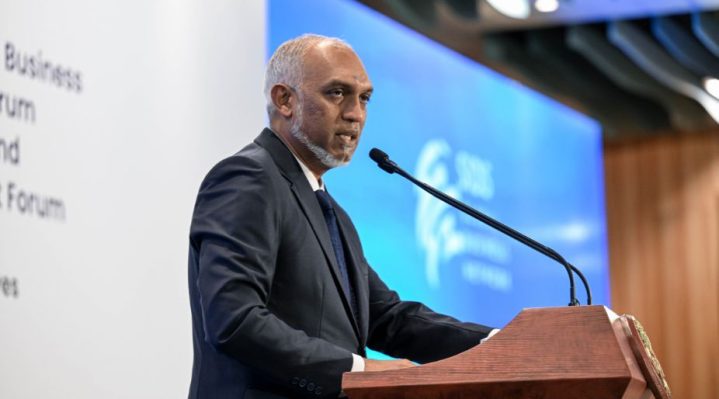
- President Muizzu urged a shift in the global investment narrative around SIDS, framing their small size as an advantage for innovation rather than only a source of vulnerability.
- Speaking at the SIDS Global Business Network Forum 2026 and inaugural Island Investment Forum, he highlighted MSMEs as key economic engines and island economies' ability to rapidly test technologies and solutions.
- He called for the UN to develop the Global Business Network into a central platform connecting island enterprises with finance, technology, partners and markets, and for greater SIDS-to-SIDS cooperation.
President Dr Mohamed Muizzu has called for a shift in the global investment narrative around Small Island Developing States (SIDS), arguing that their size should be treated as an advantage for developing new ideas rather than viewed solely as a source of climate and economic vulnerability.
Speaking at the opening of the SIDS Global Business Network Forum 2026 and the inaugural Island Investment Forum in the Maldives, the President said island countries should be recognised as markets for innovation, renewable energy, digital services, tourism, logistics, climate solutions and new forms of enterprise.






The forums, being held from 23 to 25 August, bring together entrepreneurs, investors, international buyers, technology providers, financial institutions and business partners to examine commercial and investment opportunities across SIDS.
President Muizzu said vulnerability represented only one part of the experience of island nations, with determination, enterprise and the ability to adapt forming an equally important part of their economic story.
“Our islands may be small. Our markets may be small, too. But our ideas do not have to be small,” he said.
He identified micro, small and medium-sized enterprises as the main engines of SIDS economies, noting that they frequently develop practical responses to challenges that governments may struggle to address independently.
The relatively small scale of island economies could also allow them to test technologies, business models and policy solutions more quickly, the President said. Successful ideas developed in one island country could then be adapted for other SIDS facing similar geographical and economic conditions.
However, he said turning those ideas into viable businesses would require access to financing, technology, commercial partners and international markets. Entrepreneurs would also need environments in which they could develop and test products before expanding their operations.
The President called on the UN Office of the High Representative for the Least Developed Countries, Landlocked Developing Countries and Small Island Developing States to develop the Global Business Network into the central platform connecting promising island enterprises with finance, technology, partners and markets.
Such a platform could help move ideas and early-stage businesses towards investment, commercial partnerships and wider market access. It could also enable solutions developed in one SIDS to reach other island countries more rapidly.
President Muizzu said greater attention should be given to investment, partnerships and technology transfers between SIDS themselves. Technologies designed for one island environment may often be suitable for other countries facing comparable limitations in scale, connectivity, energy and infrastructure.
He also called for broader cooperation between governments, investors, financial institutions, technology companies, academia and civil society. Governments would be responsible for creating conditions in which businesses could operate, while financial and commercial partners would need to expand access to capital, technology and markets.
Turning to domestic policy, the President outlined measures being pursued in the Maldives to support entrepreneurship and private-sector growth. The Government has designated 2026 as the Year of Productivity, while 2026 and 2027 have been identified as years of special focus on small and medium-sized enterprises.
These measures include a USD 6.5 million loan scheme for start-ups, with funding earmarked for women-led businesses. According to the President, the scheme has so far supported close to 200 businesses led by women.
A separate Youth Entrepreneur Financing Fund worth USD 65 million is intended to provide young entrepreneurs with capital to develop their ideas into viable businesses.
The President said financing alone would not create a complete entrepreneurial ecosystem. Business development services, entrepreneurship programmes, digital infrastructure and improved investment conditions would also be required to help local enterprises become more competitive and productive.
He pointed to the new Foreign Investment Act as part of efforts to establish a clearer framework for responsible foreign investment while protecting national interests and aligning investments with the country’s development priorities.
The Government is also working towards establishing the country’s first Trade Acceleration Zone by 1 January 2027 to facilitate MSME growth and provide incentives for participating companies.
Digital connectivity formed a major part of the President’s address. He described it as economic infrastructure capable of enabling trade, financial services, tourism, education, creative industries and new forms of employment.
Under the Maldives 2.0 agenda, the Government plans to use digital services to address the geographical and operational limitations faced by an archipelagic country. This includes making government and financial services more accessible, improving business efficiency and connecting Maldivian enterprises with international markets.
The President said the Maldives intends to raise the contribution of the digital and creative economies to 15 per cent of gross domestic product by 2030. Planned measures include regional cultural centres for heritage entrepreneurs and creator hubs where creative professionals can develop their work and establish businesses.
The Government is also expanding digital financial services for MSMEs through locally developed digital wallets, payment services including BML Swipe and the planned integration of PayPal.
Efforts to improve overseas market access include a partnership involving Authentic Maldives and Alibaba, as well as trade arrangements with China and Türkiye and ongoing discussions with India.
Physical connectivity would remain equally important for island economies, the President said. The Government is expanding sea and air links and investing in transport networks to improve the movement of people, goods and businesses between islands and overseas markets.
The development of Thilafushi International Port was identified as a strategic infrastructure project intended to expand the Maldives’ logistics and maritime capacity. The President also highlighted floating solar and other renewable energy developments as opportunities to improve energy security, reduce dependence on imported fuel and attract investment.
He said SIDS should continue seeking investment in climate adaptation and resilience, where funding could produce both environmental and economic returns. The blue economy also offered further opportunities across sustainable fisheries, marine tourism, maritime services, technology and conservation financing.
The President reaffirmed the Maldives’ commitment to cooperation between the private sectors of SIDS and to the full implementation of ABAS. He said investment in island states should be seen as a strategic investment in innovation, resilience and sustainable growth.