- Villa College is launching three new programmes for September 2026 combining Shariah and law with political science, international relations and diplomacy.
- The undergraduate degrees retain core law modules for legal licensing while offering final-year specialisation, and are accredited by the MQA and Bar Council.
- The new master's programme responds to demand for expertise in politics, foreign affairs and international engagement, preparing graduates for diplomacy and policy careers.
Villa College has expanded its Faculty of Shariah and Law with three new programmes linking legal education with political science, international relations and diplomacy.
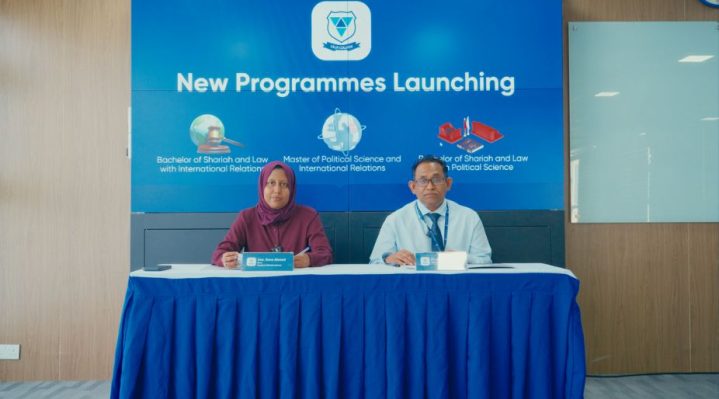
The September 2026 intake will include a Bachelor of Shariah and Law with Political Science, a Bachelor of Shariah and Law with International Relations, and a Master of Political Science and International Relations.







The two undergraduate programmes retain the core law modules required for entry into the Maldivian legal profession, while allowing students to specialise in either political science or international relations during their final year.
Students will study legal subjects including contract law, constitutional law, criminal law, the Maldivian legal system, Islamic family law and Islamic law of inheritance during the first two years. Those pursuing political science will later take modules such as comparative politics, religion and politics, and development and public policy.
Students specialising in international relations will study areas including counterterrorism and national security, Maldivian foreign policy, and the foreign policies of major powers.
Both bachelor’s degrees run for three years across six semesters and are available through e-learning and face-to-face study. Villa College said the programmes are accredited by the Maldives Qualifications Authority and approved by the Bar Council of the Maldives, allowing graduates to meet national licensing requirements.
The curriculum will also include practical legal learning through mooting, pro-bono work and the Law Student Society. Villa College is introducing experiential learning modules such as Street Law into its main legal curriculum, giving students opportunities to engage with legal issues beyond classroom-based study.
The undergraduate courses will additionally cover specialised areas such as employment law, alternative dispute resolution, and crime and punishment. The college said this is intended to give students earlier exposure to different legal fields before they enter professional practice.
The new master’s degree responds to demand for expertise in politics, foreign affairs and international engagement, according to the college. It will cover global governance, international organisations, diplomacy and negotiations, geopolitics in South Asia, and security studies, before concluding with a dissertation.
Graduates of the postgraduate programme may pursue careers in foreign affairs, diplomacy, international organisations, non-governmental organisations, policy analysis, academia, research journalism and public administration.
The master’s degree is structured across three semesters and will also be offered through e-learning and face-to-face formats.
Villa College said the programmes form part of its effort to prepare students for a labour market that increasingly requires legal knowledge alongside an understanding of policy, diplomacy and international affairs.
Applications are open for the September 2026 intake. Entry to the bachelor’s programmes requires two GCE A-Level or HSC passes, a related Level 4 qualification, or a relevant foundation programme. Applicants for the master’s programme need a bachelor’s degree or related Level 8 Graduate Diploma, while alternative entry routes based on work experience are also available. Law degree applicants must meet the English-language standard set by the Bar Council.