- The Maldives Retirement Pension Scheme holds MVR 30.3 billion, about a quarter of the economy, invested almost entirely at home.
- Because the fund is large and domestically concentrated, members' retirement savings are tied to the Maldivian economy's climate resilience.
- Climate threats to coral reefs, tourism and fisheries, which underpin GDP and employment, pose risks to long-term pension security.
- Climate threats to coral reefs, tourism and fisheries, which underpin GDP and employment, pose risks to long-term pension security.
Every month, 7 percent of your pensionable wage goes towards your retirement savings, with your employer contributing another 7 percent. Over time, these contributions are invested to help build financial security for retirement. But the value of those savings is also influenced by wider economic conditions, including how the Maldives responds to climate-related challenges.
The Maldives Retirement Pension Scheme (MRPS) is a defined contribution scheme. That means your retirement savings are made up of two things: the money paid in by you and your employer, and the returns earned when that money is invested. The Maldives Pension Office lists three factors that decide how much you retire with: your salary, how many years you contribute, and investment returns.






The scheme is large. By the end of September 2026, MRPS had 204,549 participants, of whom 194,053 had savings in their accounts, according to data published by the Maldives Pension Office. The fund had grown to MVR 30.3 billion. That is about a quarter of the size of the whole economy, based on the Maldives Monetary Authority’s (MMA) GDP projection for 2026.
Almost all of that money is invested at home. The Pension Office states that MRPS has not yet made any overseas investments. Its published data show that 52.4 percent of the fund is in government Treasury bills and 24.6 percent in Treasury bonds, about three quarters in total. The rest is in fixed deposits, Islamic finance instruments and shares of Maldivian companies.
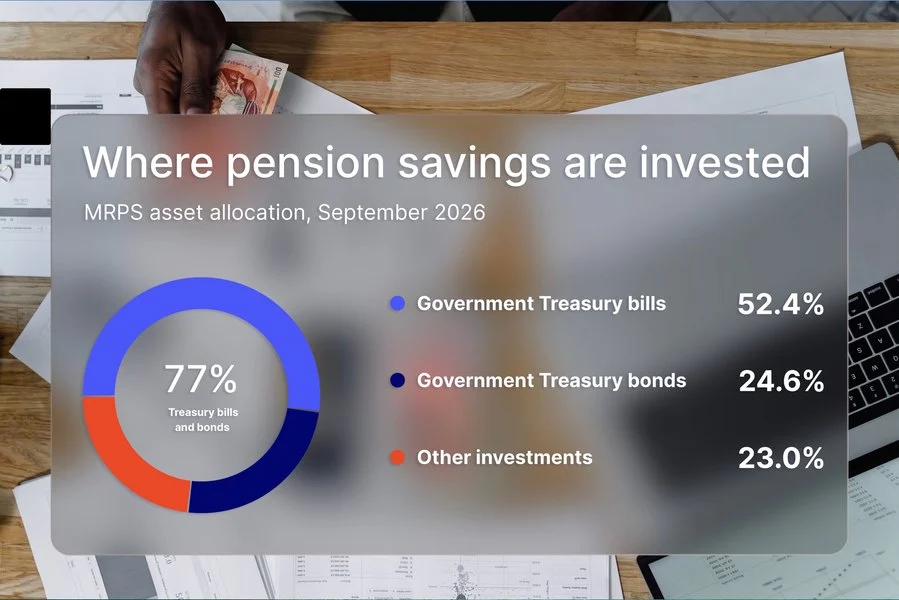
With MRPS investments concentrated domestically, the performance of the Maldivian economy and its financial markets is relevant to the long-term security of members’ retirement savings.
Why climate change is a pension issue
The World Bank has studied how exposed pension systems around the world are to climate change. It found that small island economies face the highest risk. The reasons are that their pension funds are large compared with the size of their economies, and that the funds invest mostly at home. The Maldives fits both descriptions.
The Maldivian economy rests on the ocean. Coral reefs generate at least 20 percent of GDP through tourism and fisheries, according to UNDP Maldives and AXA Climate. Those reefs are under strain. After the 2024 marine heatwave, coral mortality in the central atolls averaged 27 percent on lagoon reefs and 41 percent on ocean reefs, a study in the journal Coral Reefs found this year.
Tourism is also where many members work. Tourist resorts employ more MRPS contributors than any other type of employer, with 13,869 people across 140 resorts, according to Pension Office data.
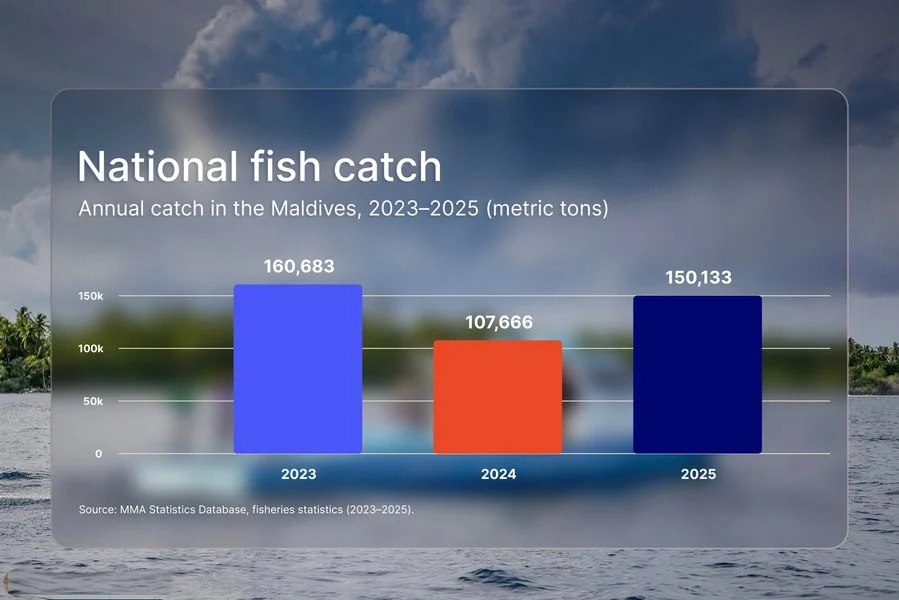
The fisheries sector illustrates how changes in economic activity can affect livelihoods. In 2024, the national fish catch declined by approximately one-third to 107,666 metric tons, according to data published by the MMA. While fluctuations in fish catch can result from several factors, they can have significant implications for communities that depend on the sector. This is particularly relevant in the Maldives, where approximately 30 percent of the workforce relies on fisheries, directly or indirectly, according to a 2024 study by the UN Economic and Social Commission for Asia and the Pacific (ESCAP).
This matters for pensions in two ways. First, when incomes fall, contributions fall, and so do retirement savings. Most members have little room to absorb a shock. Among private-sector employees in MRPS, 73 percent earn a pensionable wage of MVR 10,000 a month or less, Pension Office data show. Many of the workers most exposed to climate shocks are not in the scheme at all. Using the 2022 census, the Pension Office estimates that about one in eight employed Maldivians was outside MRPS, and ESCAP found that 76 percent of jobs in fisheries and agriculture are informal. Second, when a climate shock damages the economy, the investments that pensions depend on are affected too.
What counts is what your savings can buy
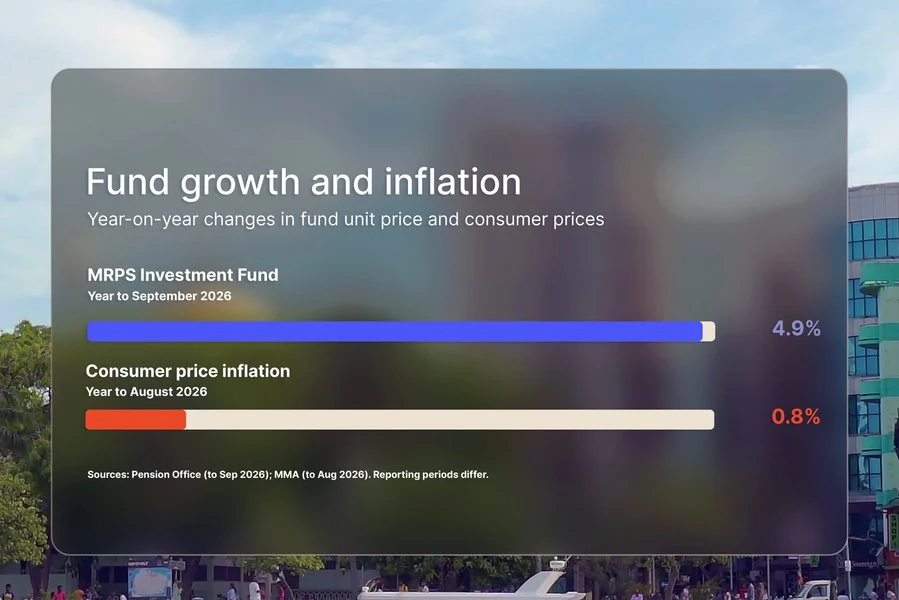
A pension has to do more than grow. It has to grow faster than prices. Over the year to September 2026, the unit price of the MRPS Investment Fund, where most members’ savings sit, rose 4.9 percent, according to Pension Office data. Prices rose 0.8 percent in the year to August 2026, MMA data show, so members came out well ahead. That is not always the case. In 2025, inflation was 4.0 percent, and the fund’s real gain in the year to September 2025 was 1.38 percent, according to the International Organisation of Pension Supervisors (IOPS).
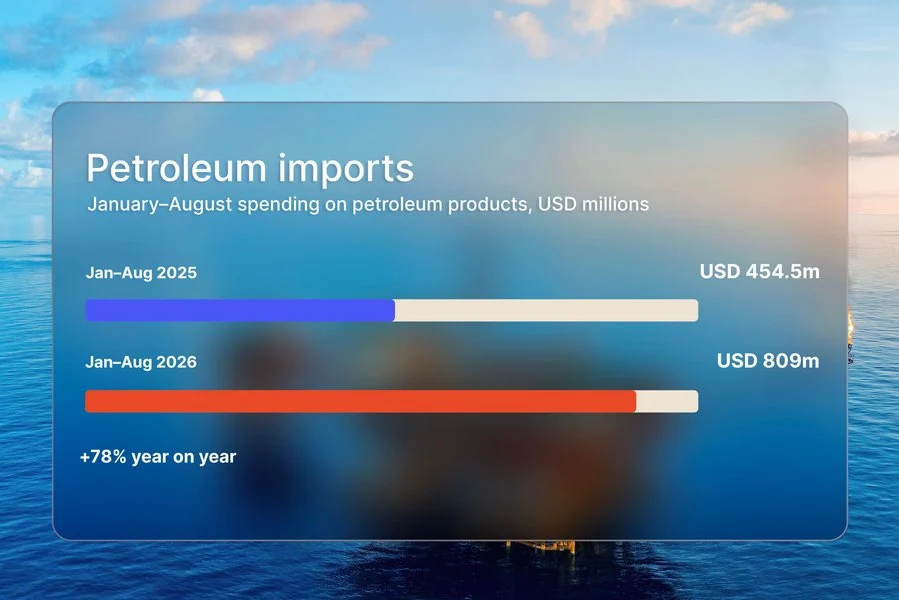
If prices rise as fast as your savings, you are no better off. Climate risk can push prices up. The Maldives is heavily dependent on imported fuel, the Ministry of Tourism and Environment said in March 2026. The country imported USD 710 million of petroleum products in 2025, according to Maldives Customs Service data published by the MMA. In the first eight months of 2026, that bill reached USD 809 million, 78 percent more than in the same period of 2025. Fuel runs the country’s electricity, boats and food supply chains.
Where green finance comes in
Green finance means lending or investing money in projects that reduce climate risk and also earn a return. It is not charity. For a pension fund, the best of these projects offer what long-term savers need: steady, predictable income over many years.
Solar power is one example. Invest Maldives is presenting a USD 500 million opportunity to install 200 MW of solar, with battery storage, across 187 inhabited islands. According to its project sheet, the investment would be backed by government power purchase agreements, which are long-term contracts to buy the electricity produced. Private investors are already lending to Maldivian solar. In 2025, Swiss investor responsAbility announced a USD 20 million facility to finance 16 MW of solar projects here.
Other small island states show how risk can be shared. In 2018, Seychelles issued the world’s first sovereign blue bond, raising USD 15 million for marine protection and fisheries. A USD 5 million World Bank guarantee and USD 5 million in low-cost funding from the Global Environment Facility made it safer for investors. Marine protected areas under management grew from about 5 million to 22 million hectares. A year earlier, Fiji became the first developing country to issue a sovereign green bond, raising USD 50 million for climate resilience.
Green finance is not automatically safe. A green label does not make a project a good investment. For pension funds, potential green investments must be assessed against the same financial, governance and risk management requirements as other investment opportunities. Environmental benefits alone do not determine investment suitability.
In its 2024 review of the Maldivian financial sector, the World Bank and the International Monetary Fund recommended that the Capital Market Development Authority, which supervises pensions, consider climate-risk and sustainability guidelines for pension investment.
The conversation on 14 November
These questions are the focus of the Maldives Finance Forum 2026, organized by the Maldives Pension Office with UNDP Maldives as its collaboration partner. The 13th edition takes place on 14 November 2026 at dusitD2 Feydhoo, under the theme “Green Finance: Unlocking Sustainable Investment and Financial Security in the Maldives.”
The Forum brings together policymakers, regulators, financial institutions, development partners and international experts. Its sessions will look at how climate risk affects households and livelihoods, how regulators can build trust in green investments, and what it would take to turn climate vulnerability into investment opportunity.
For MRPS members, the stakes are personal. Your pension is invested in the Maldives. A Maldives that can withstand climate shocks is a safer home for your savings.