- President Muizzu pushed at COP31 for grant-based climate funding and finance assessments based on climate vulnerability, not just income.
- He sought affordable financing for renewable energy, coastal protection, and better warning systems, citing Hulhumalé and Rasmalé as examples.
- He met World Bank and UNDP leaders, backed Palestinian statehood, while First Lady Sajidha urged producer responsibility for packaging waste.
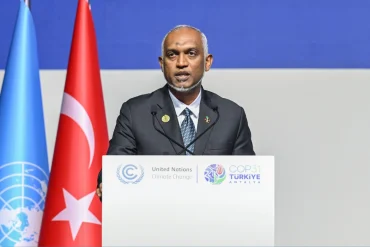
President Dr Mohamed Muizzu used COP31 to press for more climate grants and changes to how international lenders assess small island states, arguing that expensive borrowing to protect communities from rising seas leaves governments with less to spend on development. He returned to the Maldives on 14 November after attending the Antalya Leaders’ Summit in Türkiye.
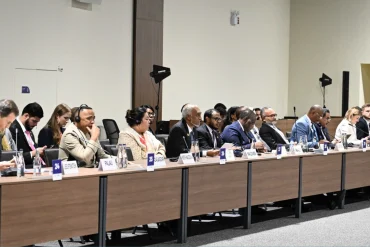
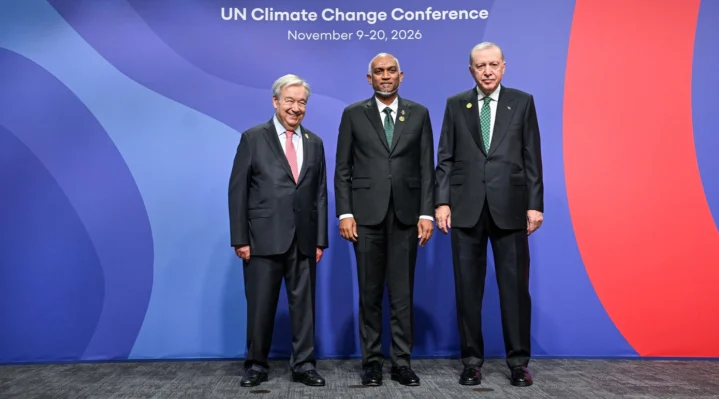
In the Maldives’ national statement, President Muizzu called on developed countries to provide predictable, grant-based funding and replenish the Green Climate Fund, the Adaptation Fund and the Loss and Damage Fund. At a Paris Agreement roundtable and a meeting of the Alliance of Small Island States with UN Secretary-General António Guterres, he made the case for assessing countries’ access to finance using measures of climate vulnerability alongside income. He also urged financial institutions and credit rating agencies to account for the long-term economic benefits of investing in climate resilience.






President Muizzu pointed to the October accreditation of Maldives Finance and Leasing Company by the Green Climate Fund as a practical step towards improving access. The accreditation gives the Maldives its first national institution able to submit projects directly to the fund for approval.
At a meeting on clean energy and electrification, the President sought affordable financing and access to technology to expand renewable generation and battery storage across the islands. The Maldives aims to generate 33 per cent of its electricity from renewable sources by 2028. He linked that target to reducing the country’s reliance on imported fuel and highlighted the higher cost of building and maintaining power infrastructure across dispersed islands.
In separate sessions on sea-level rise and disaster preparedness, President Muizzu called for coastal protection to be built into development plans and for better forecasts and warning systems that can reach island communities. He cited Hulhumalé and the planned Rasmalé development as examples of how the government is factoring sea-level rise into urban planning, alongside efforts to protect reefs and mangroves that act as natural coastal defences.
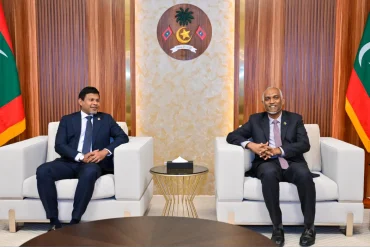
On the sidelines, President Muizzu met World Bank Group President Ajay Banga and discussed climate resilience and future cooperation with UN Development Programme Administrator Alexander De Croo. In a separate meeting with Palestinian Prime Minister Mohammad Mustafa, he reaffirmed Maldivian support for an independent Palestinian state along the pre-1967 borders, with East Jerusalem as its capital.
First Lady Sajidha Mohamed used the Global Zero Waste Alliance meeting to call for producers to take greater responsibility for packaging and the waste it generates. She said import-dependent countries such as the Maldives bear the cost of dealing with discarded packaging and warned of the damage marine litter causes to reefs, wildlife and the food chain.
COP31 negotiations continue through 20 November. Any new funding commitments for the Maldives arising from the President’s visit remain unconfirmed.