When Tourism Promotion Becomes a Holiday: The Problem With Oversized Delegations
- Government tourism delegations to international fairs risk appearing as publicly funded holidays without clear records of officials' roles and costs.
- Visit Maldives spent MVR 51.8 million on fairs in 2025, but accounts don't break down per-event or travel costs.
- Post-trip reports emphasize photos and ceremonies over measurable business outcomes, leaving the public unable to assess whether large delegations were justified.
Every year, national tourism bodies send delegations to international trade fairs in cities such as Berlin and Dubai. On paper, these trips are about selling the destination to the world. Without a clear record of what officials do and what their travel costs, an oversized delegation risks looking like a publicly funded holiday, with much of the direct sales work left to the private sector.
The issue isn’t that governments attend. It’s how many people they send, who those people are, and what they actually do once they arrive.






A resort or dive centre sending staff to a trade fair usually keeps its team small and focused. Each person is there for a reason: meeting tour operators, negotiating rates, talking to airlines about seasonal flights. Every cost comes out of the business’s own pocket, so there’s little room for passengers.
Government delegations can work differently. They may include officials from ministries and state bodies alongside staff responsible for promoting the destination. Some will have essential meetings or operational duties. But when their individual roles are not made clear, it is fair to ask what each publicly funded traveller is adding, particularly when leading resorts already have their own international sales teams on the ground.
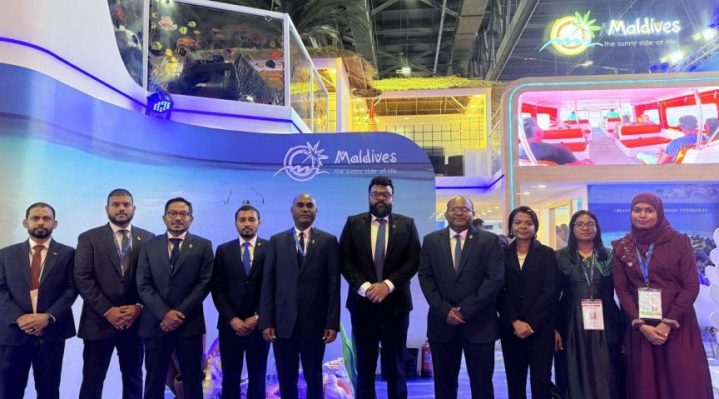
At Arabian Travel Market in Dubai this September, the Maldives was represented by 165 industry participants from 74 tourism companies, alongside officials from Visit Maldives Corporation, the tourism ministry and the Maldivian embassy. The 165 were industry representatives, not the official contingent. The costs of these trips are rarely small. Flights, hotel stays and daily allowances add to the bill for a fair, and that’s before the cost of the national stand itself.
Visit Maldives spent MVR 51.8 million on fairs in 2025, according to its audited accounts, down from MVR 89.3 million the previous year. That is a substantial reduction. Yet the accounts do not show the cost of each fair or how much was spent on official travel for each event. How many people went, what their roles were and what each trip cost remain important questions.
When delegations return, reports tend to focus on the visible side of the trip: the size of the pavilion, the opening ceremony, the ministerial handshakes and the group photos. What is harder to find is a record of the business that followed. Were new campaigns launched? Did an airline agreement lead to improved connections? Which opportunities were still being pursued months later?
Visit Maldives reported business meetings at this year’s Arabian Travel Market and signed cooperation agreements with Emirates and Qatar Airways. Those are potential outcomes worth following. A signed agreement, however, does not show what it ultimately delivered.
Without that follow-up, it becomes difficult to judge whether the scale of a trip was justified. The public is left paying for presence without enough information to assess performance.
The imbalance is harder to accept when businesses are also asked to contribute through participation fees. Visit Maldives earned MVR 22.1 million in fair participation fees in 2025. A small guesthouse or independent operator must weigh those fees and travel costs against the prospect of securing business.
That makes it important to explain how places at fairs are allocated and how the wider promotional effort benefits businesses that cannot afford to attend. A national stand should serve more than the companies able to send their own sales teams abroad.
There is also a cost in what doesn’t get funded. Travellers today often plan and book online, and digital campaigns or joint promotions with airlines can provide clearer information about enquiries, referrals and, where partners share the data, bookings. Money spent flying and housing an official without a necessary role is a rupee that could have supported other marketing work.
Visit Maldives has already shifted its spending. Advertising costs rose from MVR 3.6 million in 2024 to MVR 63.7 million in 2025 as fair costs fell. That spending needs scrutiny too. Moving money away from fairs will only help if the alternatives can also show results.
Reform does not mean tourism authorities should stop attending trade fairs. It means the trips should be tied to real work. A firm cap on publicly funded delegations could allow exceptions for officials with documented meetings or essential duties. Visit Maldives could publish how many officials are travelling, their roles, the cost of each trip and its goals. It could then review each major trip three to six months later to see what business, campaigns or partnerships followed, and reconsider funding for events that repeatedly fail to deliver.
Tourism promotion is too important, and too competitive, to be run on habit. If public money is paying for the journey, the public deserves to know what came back with it.