
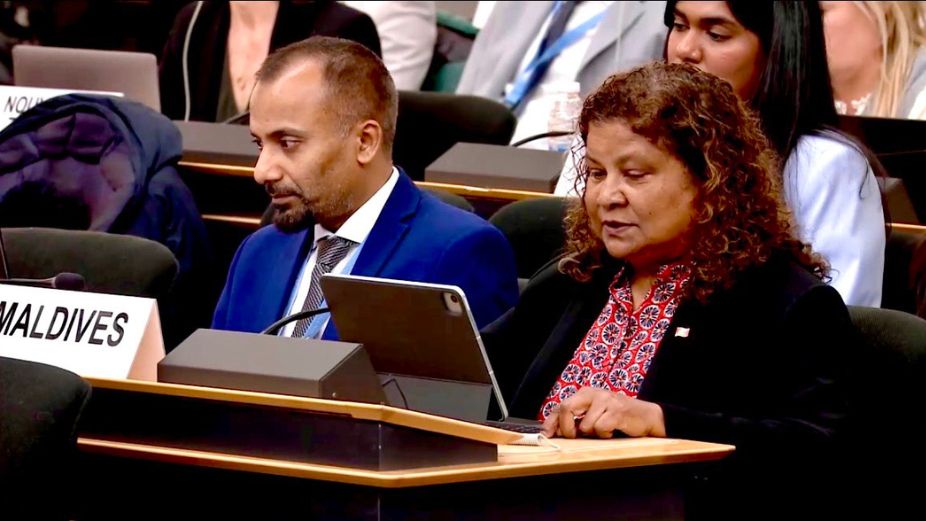






On March 25, in a chamber usually reserved for procedural language and cautious diplomacy, the Maldives spoke with unusual clarity. Its representative at the United Nations Human Rights Council condemned Iran’s strikes on Gulf states, described attacks on civilian infrastructure as unacceptable, and aligned itself with a resolution that framed those actions as “unprovoked”.
Two days earlier, in Malé, the President had been making a different kind of argument. The Maldives, he said, would not be drawn into the conflict. Its territory would not be used. Its position would remain one of non-involvement, grounded in sovereignty and restraint.
Set side by side, these two moments create a tension that runs through the country’s foreign policy. One is the language of neutrality, directed inward, emphasising distance and independence. The other is the language of alignment, delivered outward, embedded in a specific narrative about responsibility and blame. The gap between them is where the real story lies.
The statement in Geneva is worth reading closely, not only for what it says, but for how it says it. It begins from a familiar humanitarian premise: attacks on civilians and civilian infrastructure cannot be justified. That is a position few would dispute. It then moves quickly to name Iran’s strikes across a series of Gulf states, identifying both the targets and the legal implications. The framing is firm, precise, and unambiguous.
What follows is equally telling. The Maldives draws attention to disruptions in global supply chains, particularly oil and food, and to the cascading effects on vulnerable economies. This is not rhetorical filler. It anchors the statement in material concern. The conflict is presented not as a distant geopolitical contest, but as a direct threat to states like the Maldives, whose economic stability depends on uninterrupted flows through the Gulf.
Yet something is missing. The statement does not engage with the sequence of events that preceded Iran’s strikes. The broader escalation, including the initial attacks that triggered retaliation, is absent from the framing. The conflict is narrowed into a single axis: Iran acting against Gulf states. In diplomatic terms, that narrowing matters. It shapes how responsibility is assigned and how legitimacy is constructed.
This narrowing becomes more pronounced in the decision to co-sponsor the resolution. The inclusion of the term “unprovoked” is not a neutral descriptor. It carries legal weight and political intent. To adopt that language is to endorse a particular reading of the conflict, one that isolates Iranian actions from the chain of events that led to them.
At this point, the Maldives is no longer simply condemning harm to civilians. It is participating in the production of a specific international narrative. That narrative aligns closely with the position advanced by Gulf states and their partners.
Seen in isolation, this might appear as a momentary departure from neutrality. Viewed against a longer pattern, it looks more deliberate. The Maldives has, over time, adjusted its posture toward Iran in response to shifts within the Gulf. It cut ties when Saudi Arabia did. It restored them when the regional climate allowed. Its diplomatic rhythm has often followed the contours of Gulf consensus rather than an independent line.
That pattern has intensified under the current administration. Engagement with Gulf economies has deepened. Financial links, development financing, and trade relationships have become more central. Energy dependence remains acute, with the country reliant on imports that move through the very waters now under threat.
In that context, the UNHRC statement reads less like an abstract position on international law and more like a calibrated response to structural vulnerability. When oil routes are at risk and supply chains begin to strain, neutrality becomes harder to sustain in its pure form. The incentives begin to tilt. Statements acquire a strategic dimension.
This does not mean the Maldives has abandoned neutrality altogether. It continues to use its language. It condemns violence broadly in domestic communications. It calls for de-escalation and adherence to international law. There is an effort to maintain balance, at least rhetorically.
But neutrality, as practised, appears selective. It operates differently depending on the audience and the forum. In domestic statements, there is an attempt to acknowledge multiple sides of the conflict. In Geneva, the emphasis narrows, and the diplomatic weight is placed more decisively on one side of the ledger.
This duality raises a question about what neutrality actually means in this context. It may not be a fixed position, but a flexible strategy. A way of managing competing pressures rather than resolving them. Small states often navigate this space by hedging, signalling different things in different settings, maintaining room to manoeuvre.
There is a logic to this. The Maldives is not operating in a vacuum. It faces constraints that larger states do not. Its economy is exposed to external shocks. Its development trajectory is tied to relationships that cannot easily be reconfigured. In such an environment, foreign policy becomes an exercise in risk management.
Even so, there are trade-offs. When a country adopts language that aligns closely with one narrative while omitting others, it shapes how it is perceived in multilateral spaces. Credibility does not depend only on what is said, but on what is left unsaid. Consistency becomes part of that calculus.
The UNHRC statement suggests a form of alignment that stops short of being declared. It is expressed through wording, through emphasis, through the choice of which legal framing to endorse. It allows the Maldives to remain formally non-aligned while participating in a broader coalition of interpretation.
Whether this should be seen as inconsistency or as careful balancing depends on how one reads the constraints. There is a case to be made that the Maldives is doing what small states often must do: adjusting its posture in response to immediate risks while preserving the language of neutrality as a protective shield. There is also a case to be made that this approach, over time, blurs the line between neutrality and alignment to the point where the distinction becomes difficult to sustain.
The statement in Geneva does not resolve that tension. It sharpens it. It shows a country speaking in two registers at once, each shaped by a different set of imperatives. The language of sovereignty and non-involvement continues to define how policy is described. The language of selective positioning reveals how it is practised.
What remains is an open question about how long that balance can hold, and what neutrality looks like when it is repeatedly adjusted to fit the demands of the moment.