
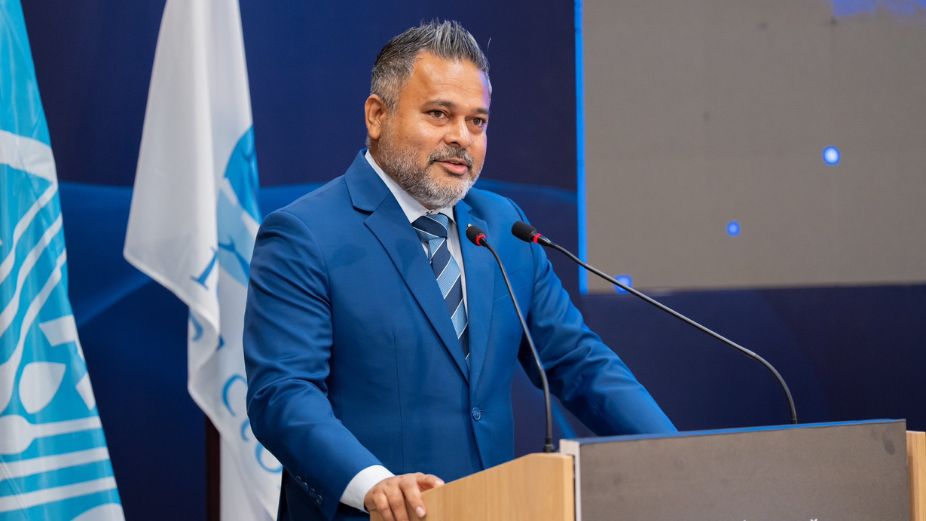




Minister of Fisheries, Agriculture, and Ocean Resources Ahmed Shiyam has said the Maldives continues to give priority to the sustainability of the fishing industry and the protection of marine life, as regional fisheries officials meet in Malé for the 30th Session of the Indian Ocean Tuna Commission.
Speaking at the session, Minister Shiyam said the work of the Commission carries direct importance for coastal communities whose livelihoods depend on tuna fisheries. He referred to the daily efforts of Maldivian fishermen, noting that their continued work at sea reflects the central place of fisheries in the country’s economy, culture, and food security.
Minister Shiyam said the government, under President Dr Mohamed Muizzu’s leadership, is working to strengthen and modernise the fisheries sector while supporting fishing families. He also said the Maldives views itself as a responsible custodian of marine resources, with fisheries policy shaped by the need to protect ecosystems for future generations.
The Minister said the decision to host the IOTC session in Malé reflects the Maldives’ commitment to regional cooperation in the management of tuna resources across the Indian Ocean. He said the sustainable management of these resources requires collective action among fishing nations, particularly as tuna stocks are shared across national boundaries.
Minister Shiyam noted that sustainability is not a recent concept for the Maldives, but a long-standing principle rooted in island communities’ dependence on healthy marine ecosystems. He said the country’s pole-and-line fishery remains an example of a low-impact fishing method that supports thousands of livelihoods while reducing harm to marine life and the wider ocean environment.
A key focus of the session is expected to be the protection and management of yellowfin tuna stocks. Minister Shiyam said the Maldives has consistently cooperated with efforts to rebuild the yellowfin tuna population, including through national measures introduced since 2016. These include changes to fishing regulations and the suspension of longline fishing.
He acknowledged that such measures can carry social and economic costs for small island developing states, particularly when communities depend heavily on fishing income. However, he said the Maldives has taken these steps because of the long-term importance of sustaining tuna resources.
The Minister also expressed hope that the IOTC’s work will recognise the efforts made by responsible fishing nations and small-scale fishers. He said decisions taken at the session will have implications beyond fisheries management, affecting coastal communities, food security, living standards, and the future of one of the world’s most important tuna resources.
For the Maldives, the discussions come at a time when fisheries policy is increasingly tied to both economic resilience and environmental responsibility. The outcome of the session will be closely watched by fishing communities and industry stakeholders, particularly on measures affecting yellowfin tuna and the future regulation of fishing activity in the Indian Ocean.