- COP31 in Antalya became the longest UN climate conference ever, ending without adopting its main political agreement as the proposed Antalya Pact failed to secure consensus.
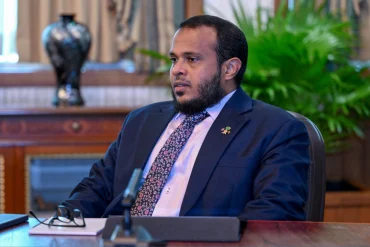
- The Maldives, voiced by Minister Ali Shareef, supported the energy transition but stressed it needs finance and technology to deliver it without raising debt or risking electricity supply.
- Key disputes centred on missing fossil fuel transition language, an emphasis on carbon capture opposed by island states, and inadequate adaptation finance provisions lacking a clear baseline.
Negotiators at COP31 closed the climate summit in Antalya without adopting its main political agreement, leaving unresolved divisions over fossil fuels and climate finance that carry direct consequences for the Maldives and other small island developing states.
The talks ended on 22 November after almost 50 hours of overtime, making COP31 the longest UN climate conference to date. The proposed Antalya Pact failed to secure consensus, with the European Union, the United Kingdom and several climate-vulnerable countries refusing to support a text they considered inadequate on emissions reductions and financial support.







For the Maldives, the outcome exposes a familiar problem: the country needs major economies to reduce emissions faster while also needing affordable finance to protect its islands and reduce its dependence on imported fuel. COP31 failed to produce an overarching agreement capable of advancing those priorities together.
Minister of Climate Change, Environment and Energy Ali Shareef captured that tension in a post on X, saying the Maldives supported the energy transition but needed finance and technology to deliver it without compromising electricity supply or increasing debt.
His intervention places financing at the centre of the country’s position. A transition away from fossil fuels requires infrastructure, technical capacity and funding that small island economies cannot necessarily provide on their own.
The central dispute in Antalya concerned the absence of explicit language on transitioning away from fossil fuels in the proposed final agreement. Countries had already agreed to that direction at COP28 in Dubai in 2023. Opponents of the Antalya text argued that leaving it out would weaken the political signal behind an existing commitment.
Reuters reported that Saudi Arabia led resistance to fossil fuel language, while around 130 countries backed a letter demanding its inclusion. Negotiators also alleged unequal access to the presidencies, an accusation the Turkish presidency rejected.
The proposed agreement’s emphasis on carbon capture added to the disagreement. The Marshall Islands and Vanuatu were among those rejecting an approach they argued could legitimise continued fossil fuel dependence. For vulnerable island states, the concern was that technological promises would displace the immediate emissions cuts needed to limit warming.
Finance created another fault line. Developing countries wanted greater certainty over the resources available to implement climate commitments, particularly for adaptation. Even some governments willing to accept the proposed pact criticised its financial provisions.
The African Group, for example, questioned language on tripling adaptation finance without a clear baseline and a proposed financing roadmap without assured delivery. Its willingness to accept the compromise illustrated how differently countries assessed the costs of a weak agreement and no agreement.
The collapse does not cancel the Paris Agreement or previous COP commitments. Countries remain responsible for implementing what they have already agreed. However, preserving those commitments leaves the practical question of how to accelerate delivery unresolved.
For small island developing states, that delay carries particular risks. The Alliance of Small Island States, or AOSIS, entered COP31 arguing that governments must minimise both the scale and duration of any overshoot of the Paris Agreement’s 1.5°C temperature goal.
That distinction matters for the Maldives. A later reduction in global temperature would not necessarily reverse damage sustained during a warmer period. The Intergovernmental Panel on Climate Change has warned that temporary overshoot can produce irreversible impacts, including losses to coral reefs.
The economic implications extend across coastal protection, tourism and livelihoods. Greater warming increases the pressure to spend on resilience while threatening the natural systems on which island economies depend. Domestic investment can reduce exposure, but its effectiveness also depends on how quickly global emissions fall.
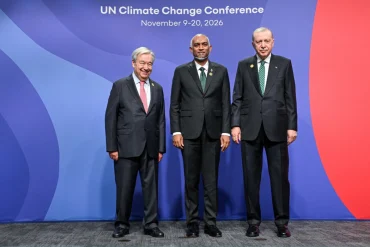
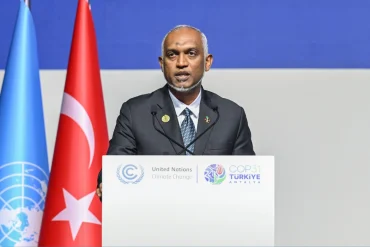
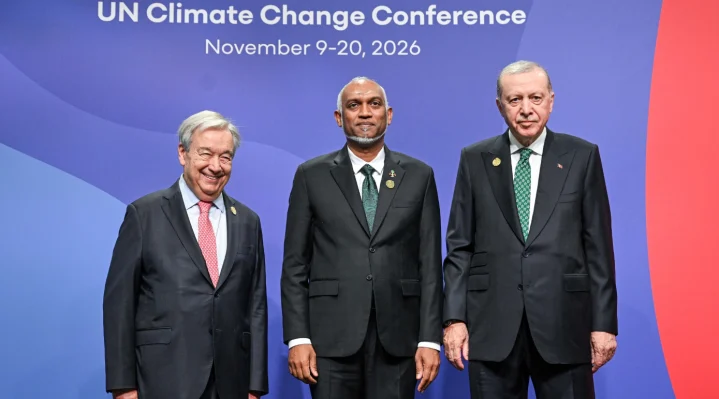
President Dr Mohamed Muizzu made finance, financial reform and implementation the Maldives’ priorities in his national statement at COP31. He called for climate finance to be additional, predictable and grant-based, and argued that resilience should not require vulnerable countries to accumulate unsustainable debt.
The financing terms are consequential. Grants can fund protection without creating repayment obligations. Loans require countries to service debt while also meeting the continuing costs of climate impacts. A larger headline funding figure therefore offers an incomplete measure of support unless its terms and accessibility are clear.
The energy transition presents a related challenge. President Muizzu told the summit that the Maldives’ dispersed geography increases the cost of developing and maintaining energy infrastructure. Expanding renewable electricity requires investment in generation and storage across separate island systems.
Reducing fuel imports could improve energy security and reduce exposure to international price shocks. Achieving those benefits requires substantial spending before the savings can be realised. Minister Shareef’s warning reflects the difficulty of financing that investment while maintaining reliable and affordable services.
COP31 did produce some useful outcomes. Parties adopted decisions on the Global Goal on Adaptation, the Adaptation Fund and the Just Transition Work Programme, despite the failure of the main pact.
Those outcomes were limited. Countries agreed to establish an expert task force to refine adaptation indicators and extended the Just Transition Work Programme for three years. Decisions on the Just Transition Mechanism’s functions and operational arrangements were deferred to COP32.
One concrete development was agreement on arrangements for the Adaptation Fund to serve the Paris Agreement exclusively once its first share of proceeds from the Article 6.4 carbon market mechanism is converted into revenue. Existing rules allocate five per cent of credits issued under the mechanism to support adaptation, providing a potential funding stream whose value depends on market activity.
The decision advances the fund’s institutional arrangements, but does not guarantee immediate funding at the scale vulnerable countries need. The fund reported a USD 2.4 billion pipeline of projects under development, illustrating the demand already facing it.
Separately, countries endorsed the voluntary 35×35 electrification pledge, which seeks to increase electricity’s share of global final energy consumption to 35 per cent by 2035. Its relevance to island states will depend on accompanying investment in clean generation, grids and storage. Endorsement alone does not finance those systems.
Loss and damage remains another urgent funding problem. At the opening of COP31, AOSIS said requests under the Loss and Damage Fund’s initial financing window, the Barbados Implementation Modalities, totalled approximately USD 2.8 billion against USD 342 million available. The gap illustrates the difficulty of responding to damage already occurring while also financing protection against future risks.
The Maldives does have an additional route through which to pursue funding. In October, before COP31, Maldives Finance and Leasing Company Pvt Ltd became the country’s first national Direct Access Entity accredited to the Green Climate Fund. It can develop and submit proposals directly, subject to the fund’s requirements and individual project approvals.
That accreditation creates an opportunity, but securing funding will still require viable proposals and sufficient resources within the international funds. Institutional access and the availability of money remain separate challenges.
COP31 therefore leaves the Maldives with a mixed but inadequate outcome: some functioning mechanisms and opportunities for investment, alongside a failed political agreement and persistent uncertainty over financing.
For small island states, rejecting a weak text can protect previous commitments from being diluted. It cannot fund coastal protection, install energy storage or compensate communities for losses. As negotiations move towards COP32 in Ethiopia, those practical needs remain the measure against which climate diplomacy must be judged.