Gov’t Says Rasmalé Project Value Parallels Total Maldivian Tourism History Asset Value
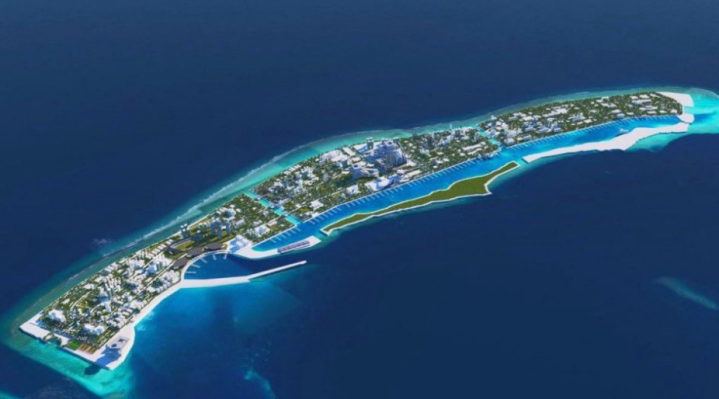
- Minister Saeed says the Rasmalé project's investment value equals the entire Maldivian tourism sector's asset value.
- The project aims to diversify the economy and achieve developed nation status by 2040.
- Opposition warns of foreign land control, sovereignty loss, and neglect of local housing needs.
Speaking at the ‘Ahaa’ public forum, Minister of Economic Development, Transport and Trade Mohamed Saeed stated that the projected total investment would match the cumulative asset value of the country’s entire tourism sector.
Saeed framed the project as a necessary measure to achieve fully developed nation status by 2040 and to diversify the economy away from its current dependency on tourism, which he reported generates USD 1.7 billion annually across 170 operational resorts.






The project has drawn sharp criticism from opposition political factions. Opponents allege that the development amounts to a transfer of sovereign territory to foreign entities and argue that properties within the zone would automatically pass through foreign inheritance. They have also raised concerns over long-term land allocation and the prioritization of large-scale urban reclamation over local housing and outer-atoll development.
In response, Saeed rejected the criticisms as politically motivated, arguing that long-term state land leases are standard practice in the Maldives. To justify the legal framework, Saeed pointed to previous administrations, noting that between 2013 and 2018, reclaimed land worth USD 1 billion was allocated on a freehold basis allowing up to 30 per cent private ownership, while legislative changes post-2018 permitted 99-year resort leases, under which 54 properties have already been assigned.
While Saeed maintained that the project would adhere to environmental safeguards and significantly boost state revenues, independent analysts and opposition figures continue to question the scale of foreign land control, financial feasibility, and environmental impact relative to the small island state’s carrying capacity.