India’s INR 30 Billion Swap Rollover Eases Maldives’ Repayment Pressure
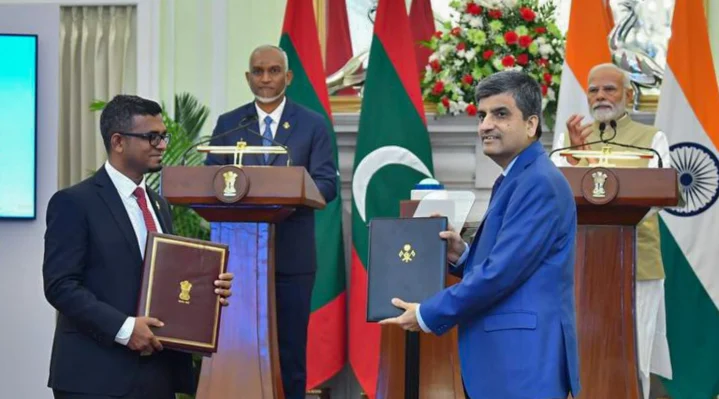
- India will roll over the INR 30 billion currency swap from 23 October, extending the Maldives' near-term repayment deadline while the underlying obligation remains.
- The rollover follows Moody's 8 October upgrade of the Maldives from Caa2 to Caa1, citing reduced external repayment pressures and improved foreign currency buffers.
- Despite the upgrade, the Maldives remains in a very high credit risk category, with Moody's forecasting a widening fiscal deficit and government debt above 100 per cent of GDP.
India’s decision to roll over an INR 30 billion currency swap will ease the Maldives’ near-term external repayment burden, extending a facility that Moody’s had identified as a significant obligation falling due this month.
The rollover takes effect on 23 October, according to India’s External Affairs Ministry spokesperson Randhir Jaiswal. It follows a request from the Maldivian government to extend the first withdrawal under the Indian rupee window of the agreement between the Reserve Bank of India (RBI) and the Maldives Monetary Authority (MMA).







The funds were initially made available on 23 April 2026. Extending the withdrawal gives the Maldives more time to repay, while the underlying obligation remains.
The decision comes shortly after Moody’s raised the Maldives’ sovereign credit rating from Caa2 to Caa1 on 8 October, maintaining a stable outlook. The agency cited reduced external repayment pressures, improved foreign currency buffers and continued access to bilateral financing.
In its 8 October assessment, Moody’s estimated that USD 411 million in public and publicly guaranteed external debt service remained payable in the final quarter of 2026, including the INR 30 billion swap due in October. India’s subsequent rollover postpones that scheduled repayment, although the statements provided do not specify the revised maturity date.
However, the upgrade left the Maldives in a rating category carrying very high credit risk. Moody’s forecast that the fiscal deficit would widen to between 8 and 8.5 per cent of GDP in 2026, with government debt remaining above 100 per cent of GDP over the next few years. It also warned that weak usable reserve coverage and substantial domestic refinancing needs continued to present risks.
The currency swap agreement was signed during President Dr Mohamed Muizzu’s state visit to India in October 2024 under the SAARC Currency Swap Framework for 2024–2027. It provided access to USD 400 million through the US dollar/euro window and INR 30 billion through the rupee window.
Currency swaps provide temporary access to foreign currency to meet short-term financing needs or balance-of-payments pressures. The MMA settled its separate USD 400 million withdrawal in April 2026, when the Maldivian government also announced approval of the first withdrawal under the rupee facility.
According to the Indian High Commission, the rupee window offers concessions covering interest rates and other conditions. It said the RBI had provided more than USD 1.1 billion in aggregate swap support to the Maldives since the regional framework began in 2012.
The High Commission also highlighted India’s subscriptions to two long-term Maldivian Treasury bonds worth USD 250 million and USD 100 million. Three Treasury bills with a combined value of USD 150 million have been settled by the Maldives, with India paying USD 42.8 million towards the interest incurred.
The Maldivian Ministry of Foreign Affairs welcomed the rollover on 16 October, expressing appreciation for India’s continued support and reaffirming the government’s commitment to strengthening bilateral cooperation.