Major-Power Rivalry Must Not Limit Small States’ Choices, Maldives Tells UN
- Vice President Latheef told the UN that major-power rivalry, debt and climate change restrict small states' choices, urging cooperation that strengthens their sovereignty and self-determination.
- He called for the Indian Ocean and Strait of Hormuz to remain open, warned rising seas won't diminish statehood, and demanded faster climate finance and COP31 delivery.
- He linked reforms of the financial system and Security Council—including a rotating small-island seat and veto abolition—to Muizzu's goal of a developed Maldives by 2040.
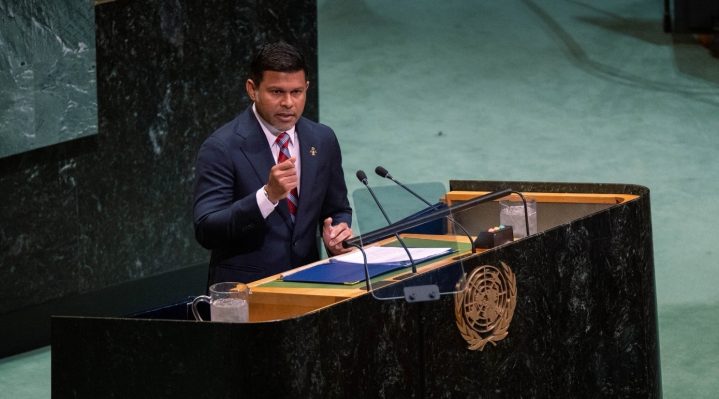
Major-power competition, debt and climate change can all restrict the choices available to small states, Vice President Hussain Mohamed Latheef told the United Nations General Assembly, calling for international cooperation that strengthens countries’ ability to determine their own future.
Speaking at the Assembly’s General Debate on 25 September, Vice President Latheef said the Indian Ocean must remain a peaceful region where trade can flow without rivalry among major powers limiting the decisions of smaller countries. He presented sovereignty as an economic concern as well as a matter of territorial security, pointing to the Maldives’ exposure to disruptions beyond its borders.






He said an interruption to traffic through the Strait of Hormuz could raise fuel prices and affect food supplies and air travel, with consequences for tourism and public finances. The Maldives condemned the closure of the strait and called for it to remain open and safe.
For small island developing states, the Vice President said climate change poses a further challenge to national planning and sovereignty. He maintained that rising seas would not diminish their statehood, rights or maritime entitlements, while calling for climate finance to reach vulnerable countries quickly and on terms suited to building resilience.
He urged countries to turn the Antigua and Barbuda Agenda for Small Island Developing States into measurable progress and said the upcoming COP31 climate summit should be judged by delivery. He also called for the first meeting of parties to the agreement on biodiversity beyond national jurisdiction to produce results from the outset.
Vice President Latheef linked those priorities to President Mohamed Muizzu’s ambition for the Maldives to become a developed country by 2040. Raising productivity, diversifying the economy, expanding renewable energy and investing in people were among the domestic measures he identified. He said access to finance, technology transfer and resilient supply chains could support that effort, while unsustainable debt and technological dependence could constrain it.
The Vice President called for reform of the international financial system and said the Borrowers’ Platform, launched earlier this year by developing countries including the Maldives, should become a lasting means for them to help shape financial decisions. He also said partnerships should build national capacity and serve countries’ own development priorities.
On UN reform, Vice President Latheef called for a rotating Security Council seat for small island developing states, wider representation for Africa and the abolition of the veto. The Maldives is seeking a Security Council seat for the 2033 to 2034 term, which he framed as part of a broader effort to give small states a role in decisions that affect them.