Maldives Climate Plan Targets Women’s Access to Finance and Decision-Making
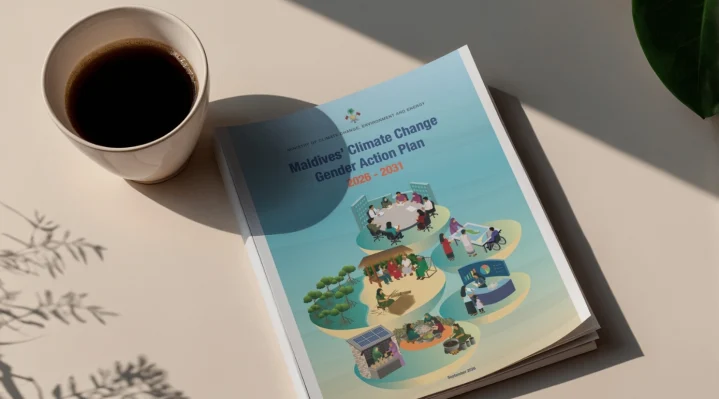
- The Maldives' Climate Change Gender Action Plan 2026–2031 prioritises women's access to finance, markets and public decision-making to address climate risks.
- Proposed measures include targeted credit schemes, mentoring, gender-responsive budgeting, and connecting women producers with resorts, schools and digital platforms.
- The plan seeks formal roles for Women's Development Committees in island climate planning and quotas for women on national adaptation committees.
Improving women’s access to finance, markets and public decision-making is a central priority of the Maldives’ Climate Change Gender Action Plan 2026–2031, which identifies economic and institutional barriers that limit their ability to respond to climate risks.
The framework, dated September 2026, proposes changes to climate budgeting, business support and island-level planning. Prepared by the Ministry of Climate Change, Environment and Energy in collaboration with the Ministry of Health, Family and Welfare, it is intended to integrate gender considerations into the country’s wider adaptation and mitigation efforts.







The plan finds that women’s contributions to climate-sensitive livelihoods, including home-based production, food security and fish processing, remain inadequately reflected in national statistics and development planning. Limited recognition can, in turn, restrict access to climate investment and institutional support.
These difficulties are compounded in the outer islands, where transport constraints, unpaid care responsibilities, limited childcare and restricted access to training and markets can reduce women’s economic opportunities. The document also identifies the additional barriers faced by women with disabilities and those working in informal livelihoods.
To address these gaps, the plan proposes targeted credit schemes for adaptation-related businesses, assistance with climate grant applications, and financial literacy training. It also envisages facilitating grants and concessional finance through SME Digital and other financial institutions.
Business support would extend beyond financing. Proposed measures include mentoring women entrepreneurs in food production, circular economy activities and nature-based enterprises, alongside connecting producers with resorts, schools, local markets and digital sales platforms. These measures are largely scheduled for the medium-term implementation period of 2027–2029.
Changes to public spending are another component. The plan calls for a gender-responsive budgeting framework and an exercise to identify expenditure benefiting women and vulnerable groups across at least three ministries involved in climate adaptation and mitigation. It also proposes applying the approach within at least one climate sector ministry’s budget cycle.
At the local level, the framework seeks a formal role for Women’s Development Committees in island climate planning. It recognises that effective participation requires greater technical capacity, financial autonomy and influence over decisions. Proposed consultation standards would address practical barriers through appropriate meeting times, childcare, transport support and accessible locations and language.
The plan also proposes quotas for women’s participation on the National Adaptation Plan’s steering and advisory committees, although it does not specify a numerical quota.
Better evidence would support these changes. Proposed actions include common requirements for collecting and sharing data broken down by sex, incorporating women’s informal work and climate-related care responsibilities into national surveys, and establishing a central gender and climate data repository.
Implementation is divided into short-term actions for 2026–2027, medium-term measures for 2027–2029 and longer-term work for 2029–2031. The climate ministry would coordinate delivery and reporting, with the health and welfare ministry providing technical leadership on gender and social inclusion.
Financing remains a condition for delivery. The document identifies government budgets, development partners and international climate funds as potential funding sources, but does not provide a costed implementation budget. It also recognises limited public financing, weak coordination, staff turnover and persistent social barriers as risks to achieving its objectives.