Pakistan Visit Widens Maldives’ Options, With India Still Central
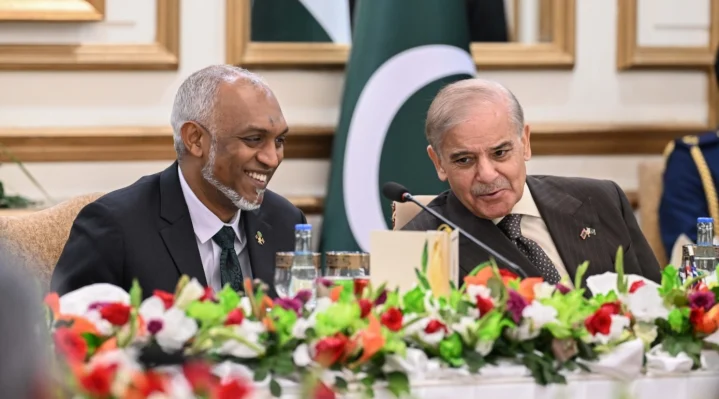
- President Muizzu's first Maldivian presidential visit to Pakistan in 11 years produced 20 MoUs and a target to raise bilateral trade to USD 200 million within two years.
- Agreements span agriculture, fisheries, healthcare, education, aviation, defence and maritime security, though details on implementation schedules and financing remain limited.
- Specific commitments include 20 annual undergraduate scholarships, government-to-government food and pharmaceutical supplies, and a feasibility study for a direct Malé–Karachi air link, while India stays central to the Maldives' economy and security.
President Dr Mohamed Muizzu’s visit to Pakistan has widened the Maldives’ options for trade, training and security cooperation, while adding a diplomatic task: developing those partnerships alongside a relationship with India that remains central to the country’s economic stability and maritime security.
The visit produced 20 Memoranda of Understanding and a commitment to raise bilateral trade to USD 200 million within two years. Its longer-term significance will depend on both the implementation of those agreements and how the Maldives manages cooperation with two South Asian countries whose relations remain deeply strained.







President Muizzu returned to Malé on 23 October following the official programme from 20 to 22 October. The first visit by a Maldivian president to Pakistan in 11 years coincided with the 60th anniversary of diplomatic relations.
The agreements cover agriculture, fisheries, healthcare, education, aviation, tourism, information technology, defence and maritime security. They establish a broader framework for cooperation, although the published announcements provide more detail on the areas covered than on implementation schedules or financing.
The economic ambition is substantial. The President’s Office cited an existing bilateral trade volume of approximately USD 13 million, against the new USD 200 million target. Reaching that level would require a considerable expansion in commercial activity and improvements in transport connections.
An agreement between the State Trading Organisation and the Trading Corporation of Pakistan provides a framework for cooperation in agricultural commodities, food and other products. Pakistan also expressed readiness to supply essential food commodities and pharmaceuticals through government-to-government arrangements.
For Maldivian businesses, additional suppliers could improve choice and create opportunities to negotiate competitive terms. Whether that translates into lower costs or more reliable supplies will depend on freight charges, product standards, payment arrangements and delivery schedules.
President Muizzu also announced that Maldivian aims to establish a direct Malé–Karachi air link. Pakistan’s Prime Minister Muhammad Shehbaz Sharif said aviation authorities had been instructed to prepare a feasibility study for direct flights. Neither announcement provided a confirmed commencement date.
Education produced a more specific commitment, with Pakistan announcing 20 additional undergraduate scholarships annually for Maldivian students. Healthcare cooperation includes recruitment of professionals and engagement between the countries’ medicine regulators.
These are potentially useful additions to the Maldives’ regional relationships. Their significance, however, sits within a much larger economic and security relationship with India.
Across financial support, essential supplies, healthcare, infrastructure and defence cooperation, India remains the Maldives’ most consequential regional partner. That assessment rests on the breadth of the relationship and the practical consequences of disruption across several sectors at once.
The financial connection was evident immediately before the Pakistan visit. India announced the first rollover of the Maldives’ INR 30 billion currency swap withdrawal on 16 October, effective from 23 October. That decision sustained an existing source of financial support at the Maldives’ request.
The relationship also extends well beyond short-term liquidity. During Prime Minister Narendra Modi’s visit to the Maldives in July 2025, President Muizzu announced a USD 565 million Indian line of credit for priority projects across sectors including housing, healthcare, education and defence.
In the same statement, President Muizzu recognised India’s contribution to essential commodity supplies and described it as the Maldives’ principal partner in healthcare. He also highlighted Indian support for housing, roads and the Greater Malé Connectivity Project.
These established commitments give the India relationship a scale and institutional depth that the Pakistan agreements would take time to develop. Expanding commercial ties with Islamabad can increase the Maldives’ options, while continuing cooperation with New Delhi remains necessary across existing programmes.
The political background makes the management of these relationships particularly important. President Muizzu’s administration sought the withdrawal of Indian military personnel operating aviation platforms in the Maldives. Those personnel were replaced by civilian technical staff in 2024, following a period of tension over their presence.
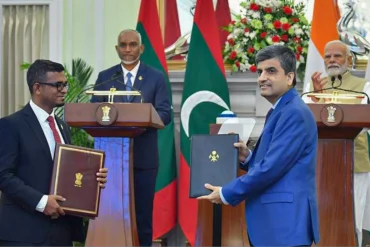
Subsequent engagement sought to stabilise relations. President Muizzu visited India in October 2024, when the two countries agreed on a vision for a Comprehensive Economic and Maritime Security Partnership. Prime Minister Modi’s visit to the Maldives in July 2025 further developed that cooperation.
Against that background, the Pakistan visit creates potential sensitivity most clearly through its security component. Separate MoUs address defence and maritime security, and President Muizzu also met Pakistan’s Chief of Army Staff and Chief of Defence Forces, Field Marshal Syed Asim Munir.
For India, the Maldives’ location near important Indian Ocean shipping routes gives maritime cooperation a direct strategic relevance. As an analytical assessment, arrangements involving operational information, surveillance capabilities or access to facilities could attract closer scrutiny than cooperation in scholarships or food supplies.
The published summaries of the Pakistan agreements provide insufficient detail to establish whether such arrangements are envisaged. Their implications for India therefore depend on the activities subsequently agreed and implemented.
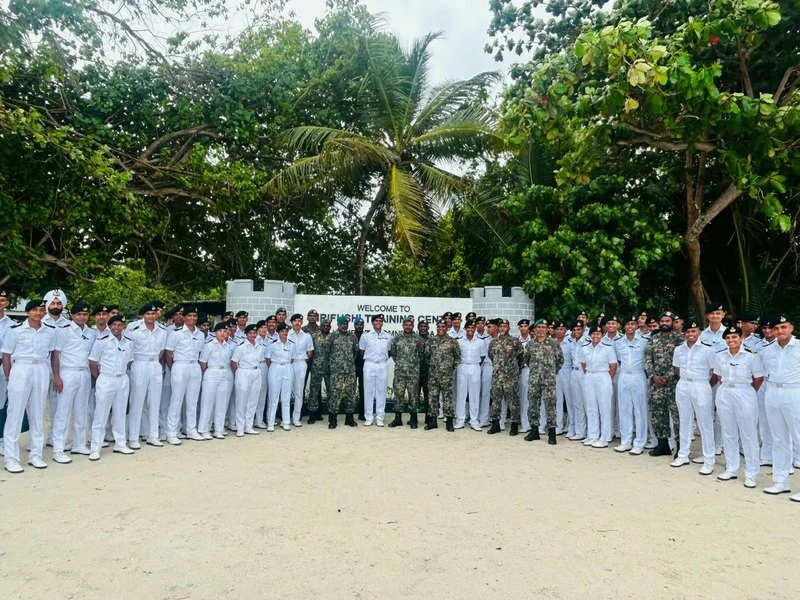
There is also concrete evidence that maritime cooperation with India continued during the Pakistan visit. India’s Ministry of Defence confirmed that INS Tir, INS Sujata and Indian Coast Guard Ship Sarathi arrived off Malé on 21 October, the day the Pakistan MoUs were exchanged.
During the port call, the squadron’s senior officer met Maldivian defence and coast guard leaders, while trainees visited the Girifushi Training Centre. These engagements show that the Maldives was pursuing cooperation with both countries simultaneously.
The diplomatic challenge is to sustain that approach through clear communication about the purpose and scope of new security arrangements. Greater cooperation with Pakistan could expand Maldivian capabilities, while uncertainty about its implementation could complicate the trust rebuilt with India.
President Muizzu’s call to revitalise the South Asian Association for Regional Cooperation adds another dimension. In Islamabad, he expressed readiness to work with all member states towards creating the conditions for an early SAARC summit.
The organisation has held no summit since Kathmandu in 2014. The planned Islamabad summit in 2016 was postponed following India’s decision not to participate and withdrawals by other members. Its unanimity requirement makes renewed summit-level engagement dependent on wider political agreement.
For the Maldives, supporting regional dialogue serves an interest in keeping cooperation available across South Asia. Delivering a summit would nevertheless require progress on obstacles that bilateral goodwill between Malé and Islamabad cannot resolve alone.
Pakistan’s official account of the visit also said Prime Minister Sharif shared his country’s perspectives on Jammu and Kashmir and the Indus Waters Treaty. President Muizzu’s published press statement did not express support for those positions. That distinction matters when assessing whether the visit changed the Maldives’ stance on disputes between India and Pakistan.
The immediate achievement was a broader set of commitments with a longstanding partner. The next stage is to demonstrate their value through trade, scholarships, professional exchanges and viable transport services, while preserving the financial, development and security cooperation already operating with India.
“But agreements are meaningful only when they produce results,” President Muizzu said in Islamabad.