- President Muizzu urged grant-based climate finance at COP31, seeking stronger support for small island states.
- A solar project in Addu City entered the Paris carbon market, transferring 433 tonnes of avoided emissions to Japan.
- The Maldives faces USD 2-4 billion in adaptation costs and high debt as it develops carbon-trading rules.
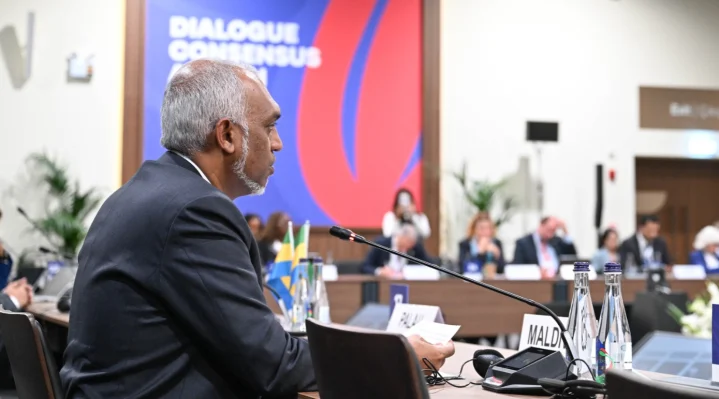
President Dr Mohamed Muizzu called for predictable, grant-based climate finance at COP31 in Antalya, Türkiye, on Wednesday, urging developed countries to honour their commitments and international lenders to give greater weight to the vulnerabilities of small island states. His national statement asked for stronger funding for the Green Climate Fund, the Adaptation Fund and the fund that helps countries respond to climate loss and damage.
Nearly a year before the speech, a solar project in Addu City had already brought the Maldives into the Paris Agreement’s carbon market. Japan acquired the right to count 433 tonnes of avoided emissions towards its own climate target after the Maldives authorised the transfer. The agreement helped bring batteries and grid technology to a city that relies on imported diesel. It also raises a question for the Maldives as it prepares national carbon-trading rules. Which emissions cuts are worth transferring abroad, and what should the country get in return?
The Cost of Protecting the Islands







The World Bank estimates that adapting to sea-level rise and related flooding alone will require between USD 2 billion and USD 4 billion. Its 2026 development update put public and publicly guaranteed debt at an estimated 129.7 per cent of GDP in 2025. An island can spend money protecting a harbour, a road or a freshwater supply and avoid years of losses. Those savings are spread across households, businesses and the state, which makes them difficult to turn into a revenue stream that pays back a loan.
That helps explain the emphasis on grants in Antalya. At COP29 in Baku, countries agreed to a collective goal of USD 300 billion a year in climate finance for developing countries by 2035. That figure covers many countries and forms of finance. For the Maldives, the practical question is how much arrives on terms it can afford and whether it can be used for the investments islands need. President Muizzu made that case separately for early warning systems, calling for better forecasts, reliable communications and warnings that reach people on the outer islands.
Some of that work is already under way. A Green Climate Fund-backed coastal resilience project aims to protect about 6.4 kilometres of vulnerable coastline and improve disaster warnings. Its approach includes preserving beaches and reefs that help protect islands from waves. In October, Maldives Finance and Leasing Company became the country’s first national institution accredited to access the fund directly. The accreditation gives the Maldives a domestic route to submit proposals, with individual projects still subject to approval.
What the Addu Deal Delivered
Every litre a utility avoids burning saves money on fuel. President Muizzu reiterated in Antalya the Maldives’ renewable electricity target, which calls for renewables to supply 33 per cent of its electricity by 2028. Its latest Paris Agreement climate plan also targets a reduction of 1.52 million tonnes of carbon dioxide equivalent in 2035, about 25 per cent below projected emissions under business as usual. That target depends on international finance, technology and other support.
In Addu, a Japanese fund administered by the Asian Development Bank supported batteries and energy management equipment for a 1.6-megawatt solar installation. The bilateral Joint Crediting Mechanism approved credits for 750 tonnes of carbon dioxide equivalent for the period from December 2021 to October 2022. Japan acquired 433 tonnes under Article 6.2 of the Paris Agreement, while 317 credits were issued to the Maldives. The public issuance records give the volumes and allocations. They provide no sale price from which to calculate Maldivian cash proceeds.
A credit can change who gets to count an emissions cut. The fuel savings and cleaner electricity stay in Addu. In the Paris Agreement accounts, the Maldives must adjust its emissions balance for the reductions it transfers to prevent both countries from claiming the same tonnes. A credible credit represents a reduction beyond what would have happened anyway. Even then, transferring the cheapest reductions can leave the country relying on more expensive cuts to meet its own target. The value of the deal depends on what the partner brings to the project and how much of the reduction the Maldives keeps.
The Rules for the Next Deal
In October, Minister of Climate Change, Environment and Energy Ali Shareef said the first draft of the national carbon-trading regulations was under review and that the government aimed to publish the rules by the end of 2026. The ministry’s consultation covered who can authorise projects, how credits are tracked and what must be reported. A UN technical review published in June identified significant gaps in the Maldives’ initial reporting, including how it authorised transfers and how the registry would track them. The Maldives has also submitted annual information on the transfer. Clear rules and published records would make it easier to see which credits have left the country and which it has kept.
Blue carbon offers another possibility. Mangroves and seagrass store carbon and support fisheries, and a 2026 UN ESCAP report examined ways the Maldives could finance their protection and restoration. A project seeking credits would have to show how much extra carbon it keeps stored or removes, and demonstrate that the benefit can last. The World Bank has flagged the high fixed costs of generating blue-carbon credits and the difficulty of reaching the scale preferred by large investors. For island councils and resorts, a mangrove or seagrass project can be worth protecting for its local benefits even where credit sales are unlikely to cover the costs.
The Maldives can judge future carbon deals by the investment they bring in, the diesel they help displace and the reductions the country keeps towards its own climate target. The finance President Muizzu asked for in Antalya has a different job. It has to reach projects such as coastal protection and early warning, where the return is measured in homes, infrastructure and livelihoods kept safe.