What the Maldives’ New GST Rules Mean for Overseas Tour Operators

- The Eighth Amendment to the GST Act brings qualifying offshore inbound tourism supplies within the tourism tax framework from 1 October 2026, taxed at the 17 per cent TGST rate.
- Foreign tour operators, travel agencies and booking platforms without a Maldives presence must register with MIRA regardless of turnover, applying within 30 days of commencement or of starting qualifying activities.
- The rules apply the destination principle, deem services supplied where recipients are not registered persons, and allow offshore resellers to subtract amounts paid to GST-registered suppliers when calculating the taxable margin.
Overseas tour operators selling Maldives holidays will need to review their pricing, contracts and accounting systems as the country extends its tourism tax framework to offshore suppliers. Qualifying businesses will face registration and tax obligations even when they have no office in the Maldives.
What has changed, and when do the rules take effect?
The Eighth Amendment to the Goods and Services Tax Act, ratified and published on 31 August 2026, brings qualifying offshore supplies of inbound tourism products and related agency and booking services within the tourism tax framework.







These supplies will be subject to the existing Tourism Goods and Services Tax (TGST) rate of 17 per cent from 1 October 2026.
The change advances the destination principle, which connects taxation to where consumption takes place. A Maldives holiday can therefore fall within Maldivian GST even when it is booked and paid for overseas.
Which operators and services are affected?
The new provisions cover qualifying supplies by businesses without a fixed place of business in the Maldives. Foreign tour operators, travel agencies and booking platforms may fall within their scope.
Inbound tourism products include accommodation, meals, transport and other tourist activities in the Maldives. Related agency and booking services are also included in the tourism classification.
However, the contractual arrangement matters. Under the new offshore place-of-supply rule, these services are deemed supplied in the Maldives where the recipient is not a registered person under the GST Act. That term includes persons legally required to register.
Operators should therefore identify who receives their service and assess that recipient’s status, particularly when dealing with other businesses. An operator reselling accommodation and an agent supplying a booking service may have different transactions to assess.
Do smaller operators need to register?
Businesses supplying goods or services covered by the relevant tourism provisions must register with the Maldives Inland Revenue Authority (MIRA) regardless of turnover. Smaller specialist operators can therefore be affected alongside larger travel companies.
Persons already meeting the applicable registration conditions must apply within 30 days of the amendment’s commencement. Businesses subsequently commencing qualifying tourism activities must apply within 30 days of starting those activities.
Businesses already registered under the GST Act when the amendment commenced do not need to apply again. Locally established operators must assess their obligations under the provisions applicable to their activities; the special offshore margin rules do not automatically apply to them.
How is the taxable margin calculated?
For a qualifying offshore resale of an inbound tourism product, the law allows the amount payable to a GST-registered supplier for that product to be subtracted from the consideration received for the sale.
The difference includes the offshore supplier’s TGST. At the 17 per cent rate, the tax component is calculated by multiplying that difference by 17 and dividing by 117.
The resale calculation should not automatically be applied to every agency fee or booking commission. Those arrangements need to be assessed according to the service supplied, its recipient and the relevant valuation rules.
What would this look like on a booking?
Suppose an offshore operator sells accommodation directly to a traveller for a final price of USD 1,200 and owes the GST-registered resort USD 1,000 in total.
Assuming the transaction falls within the special resale rules, the difference is USD 200, inclusive of the operator’s TGST.
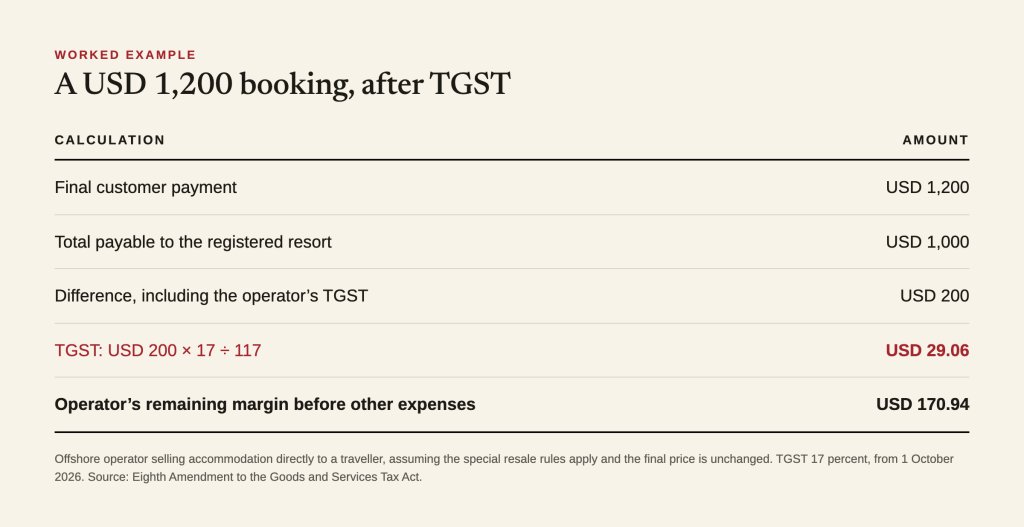
This illustrates the effect of keeping the customer’s final price unchanged. The operator retains a smaller amount after accounting for tax. Preserving a particular margin would require a pricing adjustment, subject to contractual terms and the ability to change the price.
Can operators deduct expenses or claim input tax?
The special valuation formula does not provide a general deduction for salaries, marketing, office expenses or other overheads. Those costs still have to be met from the amount retained.
Offshore suppliers covered by the input tax restriction cannot offset input tax against their output tax. The supplier payment is recognised through the margin calculation, making it essential to distinguish that adjustment from an input tax credit.
TGST accounted for by the resort does not, by itself, settle the overseas operator’s separate obligations.
What happens to bookings already confirmed?
Operators should confirm with MIRA how bookings made before 1 October will be treated.
Existing GST rules generally determine the time of supply by reference to the earlier of a tax invoice or full or partial payment, subject to exceptions. The booking date or arrival date alone should not be treated as establishing whether the new tax applies.
Advance payments, cancellations and bookings spanning the commencement date require particular attention. Operators should also review whether their contracts permit additional taxes to be passed on to customers.
How will operators report and pay the tax?
Under MIRA’s existing TGST framework, returns and payments are made in US dollars and are generally due by the 28th day of the month following the relevant taxable period.
Affected offshore businesses should confirm their applicable filing period and the registration, reporting and payment procedures as MIRA implements the provisions.
The amendment requires consequential changes to the GST Regulation within 30 days of commencement. Further clarification will be important for arrangements involving several intermediaries or packages containing both Maldivian and overseas components.
How will MIRA identify overseas suppliers?
The amendment allows MIRA to require registered businesses to provide information they possess that is necessary to ensure offshore suppliers meet their registration obligations.
A resort could therefore be asked for information about foreign tour operators or agencies to which it sells or allocates accommodation for resale. Maldivian tourism businesses should be prepared to respond to such requests.
What should operators do now?
Operators should confirm their registration position, identify qualifying Maldives sales and document the amounts received from customers and payable to registered suppliers.
They should review contracts and margins, and ensure their booking and accounting systems can support the required calculations. The amendment also requires prescribed records to be retained for five years from the last day of the relevant taxable period.
For complex packages and agency arrangements, confirming the treatment of each supply will be necessary before finalising pricing and reporting procedures.