

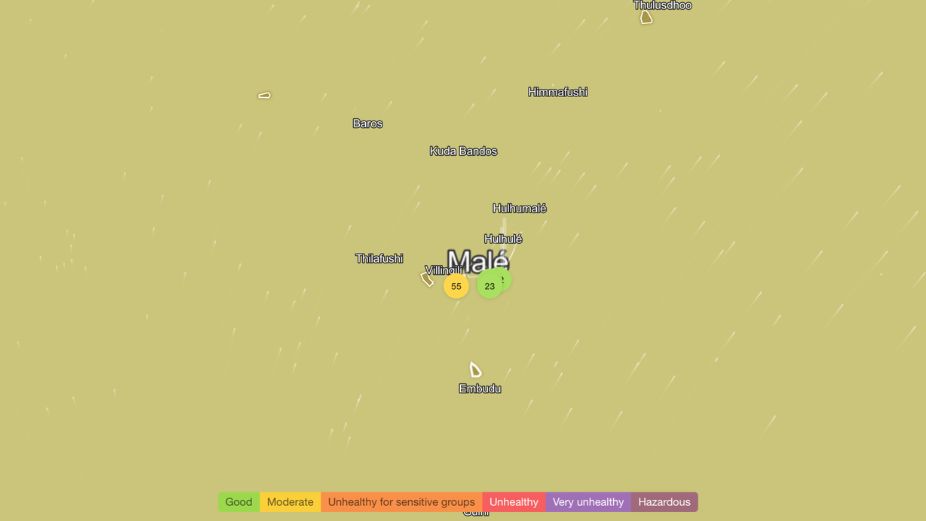






Air quality monitoring efforts are being expanded in the Malé region, where worsening haze conditions have drawn increased attention to environmental and public health risks.
The Ministry of Climate Change, Environment and Energy has stated that work is underway to establish four dedicated air quality monitoring stations within the greater Malé area this year. The planned locations include Galolhu Cemetery, Maafannu Cemetery, Hulhumalé Central Park, and Hulhumalé Phase 2, reflecting a focus on areas experiencing higher exposure to poor air conditions.
The move comes amid growing concern over declining air quality in the Maldives, particularly in densely populated urban centres. The new stations are expected to provide more detailed and location-specific data, complementing existing systems that allow the public to check air quality through mobile devices.
Monitoring infrastructure has already been introduced across seven islands, including Villingili, Sh. Funadhoo, L. Gan, Fuvahmulah City, Addu City, Dh. Kudahuvadhoo, and Kulhudhuffushi. These systems enable residents to access real-time air quality information, supporting more informed decisions about outdoor activity, particularly for individuals with respiratory conditions.
Authorities have indicated that the additional stations in the Malé region will further enhance public access to live environmental data. The objective is to make this information widely available before the end of the year, allowing users to better assess conditions in specific locations and take precautionary measures when necessary.
The expansion of monitoring capacity forms part of broader efforts to address air pollution challenges in the Maldives. This includes initiatives such as the Low Emission Transport Project, which is being implemented in collaboration with the Ministry of Transport, and is aimed at reducing emissions linked to urban mobility.
The developments suggest a gradual shift towards more data-driven environmental management, as authorities seek to improve both monitoring capabilities and public awareness in response to emerging air quality concerns.