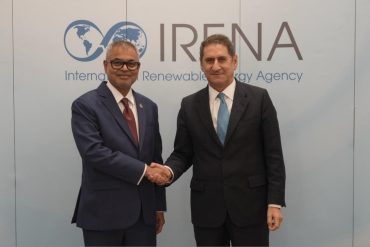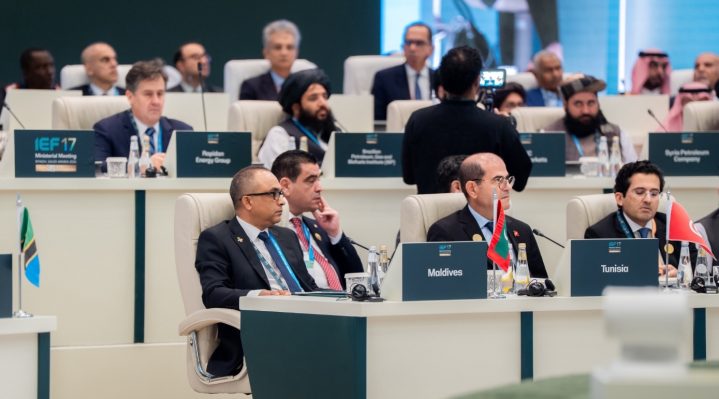
- State Minister Dr Muaviyath Mohamed represented the Maldives at the 17th International Energy Forum Ministerial Meeting in Riyadh on 11 October.
- The Maldives aims to generate 33 per cent of its electricity from renewable sources by the end of 2028, reducing reliance on imported diesel.
- Financing remains a key constraint, with high public debt and limited fiscal space hindering renewable investment across dispersed islands.
Securing reliable energy supplies and attracting long-term investment were central to international discussions joined by the Maldives in Riyadh, as the country works towards generating 33 per cent of its electricity from renewable sources by the end of 2028.
State Minister of Climate Change, Environment and Energy Dr Muaviyath Mohamed represented the Maldives at the 17th International Energy Forum Ministerial Meeting (IEF17), held on 11 October in Saudi Arabia.







Hosted by Saudi Arabia and co-hosted by Italy and Nigeria, the meeting brought together ministers, industry leaders and international organisations under the theme “Energy Security and Shared Goals in a New Era”.
The International Energy Forum provides a platform for dialogue between energy-producing and energy-consuming countries. Its discussions cover the stability of energy supplies, investment, affordability and the transition towards more sustainable energy systems.
Participants at IEF17 examined ways to strengthen energy security while reducing emissions, alongside the investment needed to maintain reliable supplies. The meeting’s concluding statement highlighted infrastructure protection, diversified supply routes, investment in electricity grids and storage, and access to finance among the priorities for cooperation.
These issues have direct economic relevance for the Maldives, where electricity generation remains heavily dependent on imported diesel. That dependence exposes the country to international fuel price changes and creates a substantial demand for foreign currency. Fuel and electricity subsidies also place pressure on public finances.
Providing reliable electricity across dispersed islands adds further challenges. Renewable energy development requires investment suited to individual island systems, including generation capacity, battery storage and grid improvements that allow greater use of solar power while maintaining a stable supply.
The government’s 2028 target concerns the share of electricity generated from renewable sources. Meeting it will require both additional installations and the supporting infrastructure needed to use that capacity effectively.
Financing remains a significant constraint. In its assessment of the Maldives’ energy transition, the United Nations Development Programme identifies high public debt, limited fiscal space and reliance on concessional financing as obstacles to expanding renewable energy investment, particularly in outer islands. It also highlights the need for projects structured to attract private capital.
The Riyadh discussions therefore addressed two connected concerns for the Maldives: maintaining dependable energy supplies while financing a gradual reduction in reliance on imported fuel.