Minister Saeed Claims Dollar Black Market Rate Returns to 2023 Level
- Minister Saeed says the dollar black market rate has fallen to around MVR 17, the level recorded when the administration took office in November 2023, down from a peak of about MVR 23.
- The government credits enforcement against unlicensed currency trading and the First Amendment to the Foreign Currency Act, which mandates conversion requirements for tourism establishments and criminalises sales above MMA rates.
- Despite the reported decline, dollar shortages persist as BML limits e-commerce transactions, telegraphic transfers face delays, and consumer prices rose 2.31 per cent with food up 6.35 per cent.
- Consumer prices rose 2.31 per cent year-on-year.
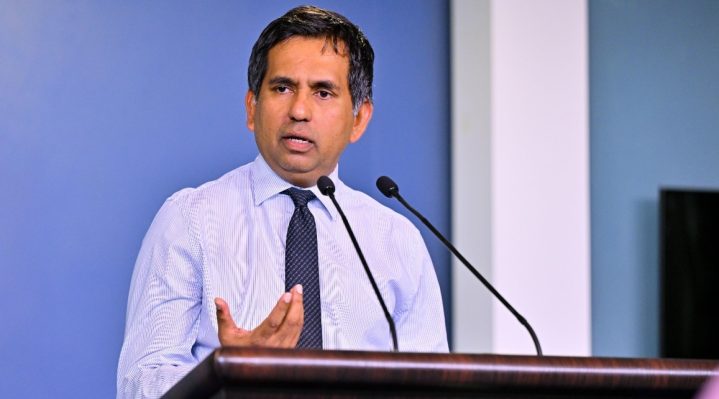
Minister of Economic Development, Transport and Trade Mohamed Saeed has said the dollar black market rate has fallen to around the level recorded when the current administration took office in November 2023.
Speaking at a press conference at the President’s Office, Saeed attributed the decline to measures introduced by the government to curb the sale of dollars at rates exceeding those determined by the Maldives Monetary Authority (MMA).







“We are receiving information that the [dollar] rate has dropped below what it was when the government was handed over to us. This means we are informed that the [dollar] rate is hovering slightly around that band, the rate it was when we transitioned from the previous administration on November 17, 2023,” Saeed said.
“That is a significant improvement.”
The dollar reportedly traded at around MVR 17 on the black market when President Dr Mohamed Muizzu assumed office. The rate later rose sharply, reaching approximately MVR 23 when the government began intensifying action against unauthorised foreign currency transactions.
The government has since strengthened enforcement against unlicensed foreign currency trading and introduced new conversion requirements intended to direct more dollars through the formal banking system.
The First Amendment to the Foreign Currency Act, which came into force on 1 September, permits foreign currency to be bought and sold only at rates or within bands determined by the MMA. It also makes the sale, attempted sale or advertisement of foreign currency above the permitted rate a criminal offence.
Under the amendment, Category A tourism establishments, including resorts, resort hotels and integrated tourist resorts, must convert 40 per cent of their monthly gross sales through a licensed bank. Category B establishments must convert either USD 25 per tourist or 20 per cent of monthly gross sales.
However, a decline in the black market rate does not by itself show that the country’s dollar shortage has been resolved. The black market does not have a transparent or independently verified exchange-rate index, while the official dollar selling rate remains MVR 15.42.
Foreign currency constraints also remain visible within the banking system. Bank of Maldives said on 12 September that the dollars required to settle international e-commerce transactions had exceeded the bank’s available foreign currency liquidity. The bank introduced daily category limits within a monthly allocation of up to USD 16 million for international e-commerce transactions made using MVR cards. It also reported delays in processing telegraphic transfers.
For households, the reported exchange-rate decline has yet to result in a noticeable reduction in everyday expenses. Consumer prices in July 2026 were 2.31 per cent higher than a year earlier, according to the Maldives Bureau of Statistics. Food and beverage prices, including fish, increased by 6.35 per cent, while transport costs rose by 8.96 per cent.
Although the overall Consumer Price Index declined by 0.24 per cent between June and July, this does not reverse earlier price increases. Businesses that purchased dollars or imported goods at higher costs may also take time to adjust retail prices, even if the unofficial exchange rate continues to fall.
Official reserve assets stood at USD 638 million at the end of July, representing a decline of 17.6 per cent compared with the same period last year.
The fall in the dollar black market rate could reduce pressure on importers if it continues. A broader improvement for households and businesses, however, would depend on greater access to dollars through banks, fewer payment constraints and a sustained easing of prices.