Minister Saeed Wants Malé to Cycle. Can Its Streets Make Room?

- Minister Mohamed Saeed proposed initiatives on 9 September to make walking and cycling fashionable again in Malé, citing that pedestrians have only about 18 per cent of road space.
- Congestion habits have spread from the old capital to planned Hulhumalé, where parked cars and motorcycles on pavements narrow wider roads intended for moving traffic.
- A March 2025 study counted 119,472 vehicles in Greater Malé, 103,300 of them motorcycles, showing that reliable alternatives and safe routes are essential before cycling can become an ordinary choice.
When Minister Mohamed Saeed called for a return to cycling, he reached for a version of Malé that many people would recognise from memory: the capital of the 1970s, 1980s and 1990s, when bicycles were a more familiar part of everyday life.
Speaking on 9 September, the Minister of Economic Development, Transport and Trade proposed initiatives to make walking and cycling fashionable again. He presented the bicycle as both a means of transport and a way towards a healthier society.






The ambition is reasonable. The difficulty is finding somewhere to put it.
At the same briefing, Saeed cited surveys suggesting that pedestrians had been left with only around 18 per cent of Malé’s road space. His own description of the capital exposed the problem facing the cycling revival he wanted to encourage: the street has become a place where people must negotiate for the space to move.
A bicycle requires little room compared with a car. It still requires a safe route, a manageable crossing and somewhere to stop. Before cycling can become an ordinary choice again, the city needs to make those ordinary things possible.
The congestion has moved with the city
Malé’s narrow streets offer a convenient explanation for its traffic. There are too many vehicles and too little land. Yet across the bridge, where Hulhumalé had the advantage of being planned with wider roads, familiar problems are taking shape.
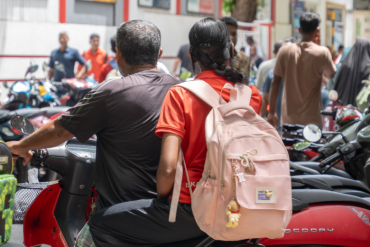
Cars occupy the sides of roads intended to carry moving traffic. Motorcycles take over pavements. Buses must work their way through lanes narrowed by parking, while passengers boarding and leaving taxis create further interruptions. Photographs taken in Hulhumalé earlier this month document these conditions across the growing city.
The significance lies in where this is happening. Greater Malé has expanded, but the habits and decisions that crowded the old capital are travelling with it. Additional road space offers only temporary relief if it is gradually surrendered to parked vehicles.
A March 2025 assessment by the Islamic University of Maldives put the number of vehicles used in Greater Malé at 119,472, of which 103,300 were motorcycles. The figures describe the situation assessed then, but the dominance of motorcycles is essential to understanding the problem. A transport policy built around cars alone would overlook most of the vehicles competing for space.
For an individual commuter, owning a motorcycle can be a practical response to an inconvenient journey. It provides flexibility and makes several daily stops easier to manage. When enough people make that choice, however, they help create the conditions that persuade others to do the same.
Breaking that pattern requires alternatives people can rely on. Someone weighing up a bicycle journey will consider the most dangerous part of the route, even if the rest is perfectly manageable. One difficult junction can decide how the whole journey is made.
A road can be crowded and unsafe
Hulhumalé’s road-safety figures give that calculation weight.
Police figures for the first seven months of 2026 recorded 1,295 traffic accidents in Hulhumalé, accounting for approximately 64 per cent of the 2,018 incidents reported nationwide. Of the Hulhumalé total, 887 were recorded in Phase I and 408 in Phase II. These figures count reported accidents, including incidents that did not result in serious injury.
Police have identified failure to slow down and incorrect lane use at roundabouts as recurring problems. Speeding, distracted driving and unsafe overtaking also feature in their account of the risks facing road users.
These are related to the wider transport problem, but they cannot all be explained by congestion. A road that barely moves during a busy period can allow dangerous speeds when traffic clears. Reducing queues will not automatically make it safe to cross or cycle along.
This matters for the government’s appeal to healthier habits. A person deciding against cycling may be responding rationally to the conditions outside. Encouragement has limited value if taking it up means accepting a journey that feels unsafe.
The consequences of a crash also continue well beyond the road. Treatment and rehabilitation cost money. Recovery can keep a person away from work, while a serious injury can permanently affect earning capacity. The World Health Organization includes these losses among the economic costs of road crashes.
For a country seeking greater productivity, preventable injury is a loss of human capacity as well as a public-health concern. A transport system that regularly exposes its users to harm carries costs that cannot be read from a traffic count.
What the traffic takes
Congestion imposes a less dramatic expense every day. For a delivery business, a longer journey can mean fewer orders completed during a shift. For a technician moving between appointments, time spent in traffic is time unavailable for another customer. Businesses must absorb the reduced capacity, commit more resources or try to recover the cost through prices.
Unpredictability adds another burden. People leave earlier because they cannot be certain how long a journey will take. Businesses allow wider delivery windows or build spare time into schedules. Even when the worst delay does not occur, time has already been set aside against it.
There is no need to attach an unsupported rufiyaa figure to recognise the economic problem. Establishing its scale would require local evidence on travel times, operating costs and lost working hours. A credible measurement would also give the government something useful against which to assess its reforms.
The allocation of road space matters just as much. A vehicle left beside a shop may occupy space that could serve several deliveries, provide a clear walking route or improve visibility at a crossing. Each use serves a different purpose, and leaving the decision to whoever arrives first is a poor way to manage a scarce public resource.
Businesses still need loading access. People with limited mobility still need convenient places to board and leave vehicles. A better street must account for these needs while allowing everyone else to pass.
What greener cities actually changed
Cities that have made cycling more practical offer a useful response to Saeed’s ambition. They show what lies behind the image of residents moving comfortably through the streets on bicycles.
Paris committed more than EUR 250 million to its 2021–2026 cycling plan, following an earlier EUR 150 million programme. The work addressed connected routes, safer intersections, secure parking and links between the capital and surrounding areas. The bicycle was being provided for across a whole journey.
In 2025, cycling traffic on the city’s comparable monitored network increased by 7.9 per cent from the previous year. That figure cannot isolate the effect of any single policy, but it demonstrates growing use alongside sustained investment in the conditions for cycling.
Singapore offers a particularly relevant example for a city where heat and rain complicate outdoor travel. In Tiong Bahru, the authorities partially pedestrianised Eng Hoon Street and removed roadside parking along nearby streets in 2022 to give pedestrians more space. Changes at Woodlands Ring Road included wider footpaths, covered connections and a new bus stop.
In 2024, Singapore announced around SGD 1 billion in additional funding over the following decade for its Friendly Streets programme and improvements to connections with public transport. Planned measures included more sheltered walking routes and better accessibility.
The lesson for Greater Malé is practical. Walking and cycling need space taken seriously in planning decisions. They also need to work with public transport, so that a short bicycle ride or walk can form part of a longer journey.
A greener city does not require every resident to make every trip by bicycle. It requires enough useful alternatives that a private motor vehicle stops being the default answer to so many journeys.
Give the invitation a route
The government now has an opportunity to translate its ambitions into street-level changes. The Land Transport Act ratified on 31 August designates Greater Malé as a controlled zone for registration and traffic management. It provides for a transport and mobility office, a road-safety council and a dedicated transport fund.
What residents will experience depends on how those powers are used. A useful starting point would be continuous pedestrian routes protected from parking, safer crossings and engineering reviews of dangerous junctions. Cycling routes should connect homes to workplaces, schools, shops and public transport stops. A disconnected stretch of cycle lane cannot provide that service.
Different streets will require different decisions. Some narrow roads may be better suited to reduced through traffic and very low speeds. Wider corridors may allow protected cycling routes. Loading arrangements, access for people with disabilities and the needs of businesses should be built into those decisions.
Reliable buses belong in the same programme. Restrictions on parking and vehicle use become more workable when people have a dependable alternative. Those who cannot cycle should gain from the changes too.
There is no reason to wait for congestion to disappear before making room for bicycles. Providing safe alternatives is one way to reduce it. But asking people to change their habits without changing the conditions places too much responsibility on the person making the journey.
Saeed’s invitation could become the beginning of something useful. Its credibility will be decided by whether a resident can leave home, reach a destination and return safely. Once that journey is straightforward, the bicycle will need much less persuasion.