Within a day this week, two announcements offered a clear picture of Maldivian foreign policy under President Mohamed Muizzu.
The Maldives formally joined a Saudi-led maritime military alliance created to protect shipping through the Red Sea, the Gulf of Aden and the Bab el-Mandeb Strait. Hours later, the Government announced that it had repaid the final USD 50 million of a USD 150 million Treasury-bill facility subscribed to by the State Bank of India in three tranches in 2019.







One announcement looked west, towards a new security arrangement centred thousands of kilometres from Malé. The other concerned an old financial relationship with the large neighbour immediately to the north. Together, they captured the contradiction at the centre of “Maldives First”: the Government has searched farther abroad for strategic partners even as debt, trade, security and simple geography have repeatedly pulled it back towards India.
Muizzu’s foreign policy was sold as independence. It has instead left the country with more partners, but less clarity about which relationships matter most.
For much of its modern history, the Maldives followed a consistent diplomatic instinct. It cultivated relations widely, defended its sovereignty and avoided becoming an appendage of a larger power. But within that engagement, it treated India as its closest strategic neighbour.
This was not merely sentiment. India intervened during the 1988 coup attempt and responded after the 2004 tsunami, Malé’s 2014 water crisis and the pandemic. Its proximity allowed assistance to arrive faster than more distant friends could provide it.
The MDP governments of Mohamed Nasheed and Ibrahim Mohamed Solih made that hierarchy explicit through an “India First” policy. Their mistake was sometimes failing to explain or place sufficient safeguards around a relationship that extended into politically sensitive areas, including military personnel and the Uthuru Thila Falhu dockyard.
Those concerns deserved scrutiny. No neighbour should be exempt from transparency. But the policy had an intelligible centre: the Maldives could work widely while recognising that its nearest neighbour occupied a category of its own.
The PPM-PNC tradition took a different course. President Abdulla Yameen turned towards China to build the Sinamalé Bridge, expand Velana International Airport and construct housing. The projects changed the physical landscape, but left the country heavily exposed to Chinese debt.
Yet Yameen’s alignment, whatever its costs, was also legible. Beijing knew what it was being offered. New Delhi knew where it stood. Muizzu sought to replace both “India First” and an overt Chinese alignment with something more ambitious: a foreign policy in which the Maldives would recognise no hierarchy at all.
His first bilateral visit was to Türkiye. His first state visit was to China. Türkiye supplied Bayraktar surveillance drones and later concluded a preferential trade agreement with the Maldives. Gulf states and Islamic financing institutions were courted for capital and political support.
Each relationship had value. Together, however, they did not amount to a replacement for India.
The problem became unavoidable in 2024. Foreign-exchange reserves were under severe pressure, large external repayments were approaching and Fitch lowered the Maldives’ sovereign rating to CC. The Government that had come to office promising to reduce Indian influence needed a financial backstop. India rolled over USD 100 million in Treasury bills and made available currency-swap facilities of USD 400 million and INR 30 billion.
The Treasury bills reveal how deep that support ran. Of the USD 150 million subscribed by SBI in 2019, repayment of USD 100 million was extended six times and the remaining USD 50 million four times. The Maldives ultimately repaid the principal, completing settlement on 17 September 2026. According to figures reported after the settlement, India absorbed approximately USD 43 million in interest costs over five years.
The relationship also reaches beyond emergency lending. India has approved what has been described as its highest annual export quotas for essential foods and construction materials to the Maldives for 2026–27, continuing a bilateral supply mechanism operating since 1981.
These quotas are not a ceremonial feature of diplomacy. They protect Maldivian access to rice, flour, sugar, onions, potatoes, eggs, aggregate and river sand, including when India restricts exports to control prices in its domestic market. They connect the relationship directly to the cost and availability of food and construction materials in the Maldives.
Local reporting also places Indian-backed subscriptions to two longer-dated Maldivian Treasury bonds at USD 350 million, with repayments due in 2029 and 2030. Taken together with the INR 30 billion currency swap, the recurrent Treasury-bill support and India-funded credit lines, this represents something larger than occasional assistance. It is part of the financial scaffolding around the Maldivian state.
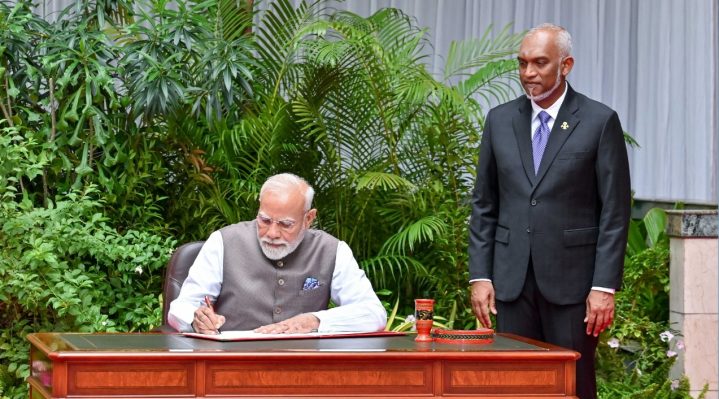
The diplomatic language changed with that financial reality. Muizzu travelled to New Delhi in October 2024. By July 2025, Narendra Modi was in Malé as guest of honour for the 60th anniversary of independence, announcing an INR 48.5 billion line of credit and relief on repayments attached to existing Indian credit lines.
The Maldives returned the USD 400 million swap in April 2026. These repayments are material achievements and should not be dismissed.
But repayment does not erase the lesson of the crisis. When the Maldives needed immediately available liquidity, repeated extensions or protected access to essential imports, it was India that provided them. The Government could change its rhetoric more quickly than it could change the country’s financial and supply architecture.
The same limit appeared in its relationship with China. Beijing remains an important partner. The China-Maldives Free Trade Agreement took effect in January 2025. Chinese-linked housing projects have moved forward, and agreements have been reached for a hospital in Vilimalé and other areas of cooperation.
But the rapid, debt-financed construction of the Yameen years has not returned. The proposed redevelopment of roads in Malé and Vilimalé emerged from Muizzu’s January 2024 visit to China. Letters of exchange were signed only in October 2025, and physical work is now expected in early 2027.
That does not mean China has turned against the Maldives. It means Beijing is dealing more cautiously with a highly indebted country. China may offer trade access, grants and selected projects, but it has not volunteered to become the unlimited source of capital implied by the Government’s early political turn towards it.
Türkiye has proved useful in defence and trade, but it is not a balance-of-payments provider. Gulf partners continue to finance projects and offer development loans, but they have not become an automatic financial safety net. The new ITFC framework may mobilise up to USD 1.5 billion in trade finance over five years, but trade finance is not the same as unrestricted budget support. The proposed USD 8.8 billion Maldives International Financial Centre is led by a private Dubai-based family office, not by a Gulf sovereign.
This week’s Saudi-led alliance therefore presents a difficult contrast. The Maldives is formalising a military partnership focused on distant waterways while remaining politically uncertain about the ordinary diplomatic presence of its closest neighbour.
The proposed Indian consulate in Addu makes that uncertainty visible.
The PPM-PNC opposition once used the proposal as evidence that the Solih administration was allowing India to establish an excessive presence in the south. In October 2024, however, Muizzu and Modi issued a joint vision stating that both governments would “work positively towards” opening an Indian consulate in Addu and a Maldivian consulate in Bengaluru.
When the issue returned in August 2026, the Foreign Ministry said no decision had been made to establish either mission. A final legal approval may indeed have remained outstanding. Politically, however, this was a deliberate retreat from the direction the Government had publicly accepted in New Delhi.
The retreat matters because it shows that relations with India have been repaired financially, but not resolved politically. The Government accepts Indian credit, swaps, infrastructure, protected commodity access and emergency capacity, then hesitates when the relationship requires a domestic defence. It wants the practical benefits of proximity without acknowledging what proximity means.
This is where “Maldives First” has collided with geography. Türkiye can sell drones. Saudi Arabia can lead a maritime alliance. Gulf institutions can finance imports and selected projects. China can build infrastructure and expand trade. None of these countries is a substitute for the neighbour whose ports, hospitals, markets, airspace and security capabilities sit closest to the Maldives.
Diversification remains sensible. Dependence on any single country can create political and economic risks, and the Maldives should deepen relations with Asia, the Gulf, Europe and Africa. But diversification is not the same as pretending that every partnership performs the same function.
A supplier is not necessarily an ally. A project financier is not always an emergency responder. A memorandum is not a completed project. And a distant friendship, however warm, cannot repeal the map.
The deepest departure from traditional Maldivian foreign policy is therefore not that Muizzu found new partners. It is that his Government blurred the distinction between adding relationships and replacing an anchor. Previous governments argued over how close the Maldives should be to India or China. Under Muizzu, the more basic question has become harder to answer: whom does the Maldives trust, and who can trust the Maldives to sustain the commitments it makes?
The country does not need an “India First” slogan, nor should it subordinate its sovereignty to any power. But it does need a foreign policy that recognises neighbours, identifies dependable partners and separates long-term national interest from short-term domestic performance.
Debt has already shown which countries will provide money when the Maldives cannot easily obtain it elsewhere. Geography has shown which country can respond first when a crisis arrives. “Maldives First” was supposed to overcome those constraints. Instead, it has revealed how costly it can be to ignore them.